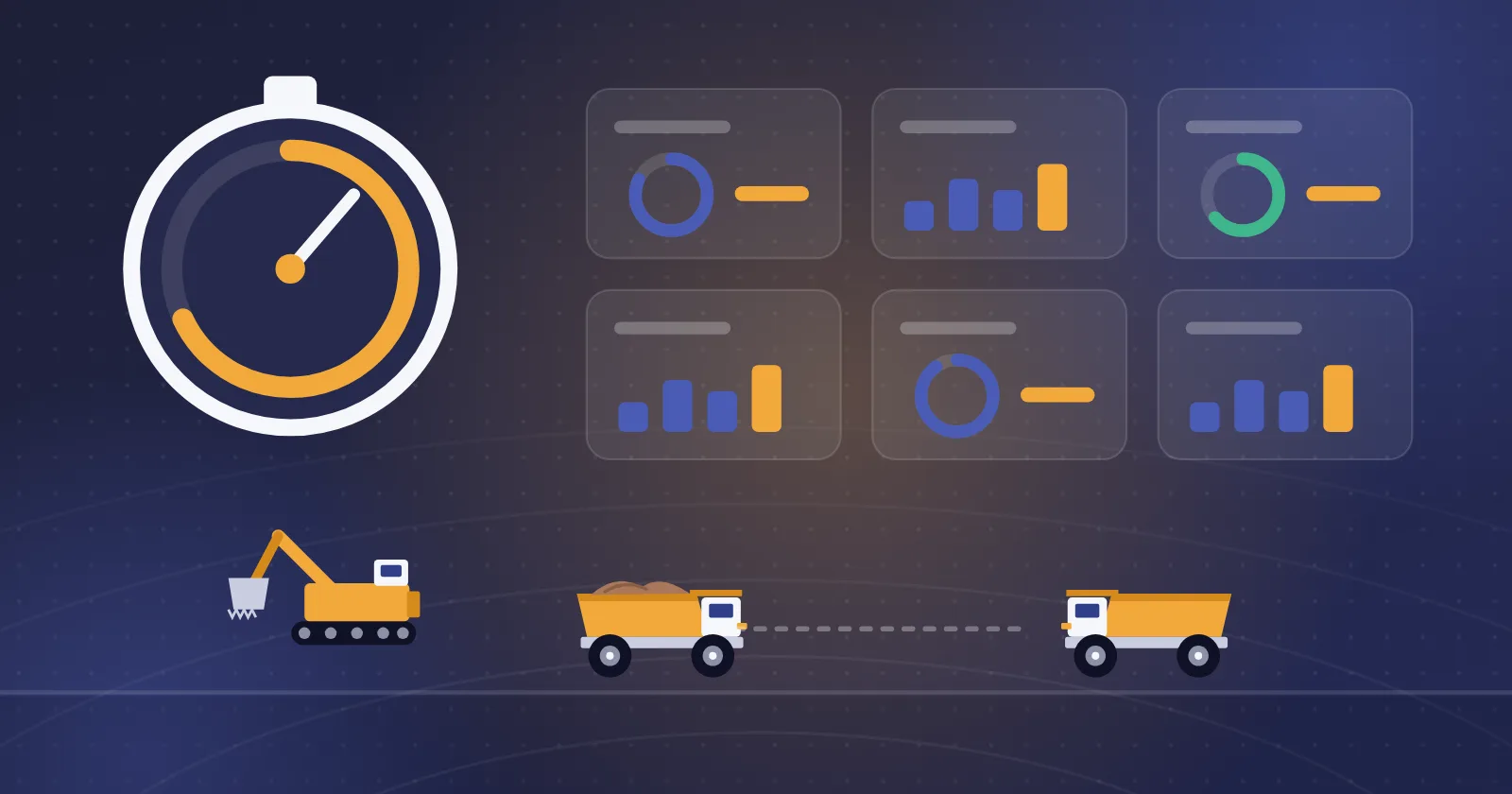
In open-pit mining, managers usually focus on large equipment, production capacity, haul cycle times and the performance of the main machines. Yet sometimes a relatively small part can set off a chain of operational problems.
The shovel bucket tooth is one of those parts.
It sits on the front of the shovel bucket and is under constant stress and wear as it digs into the rock face and loads material.
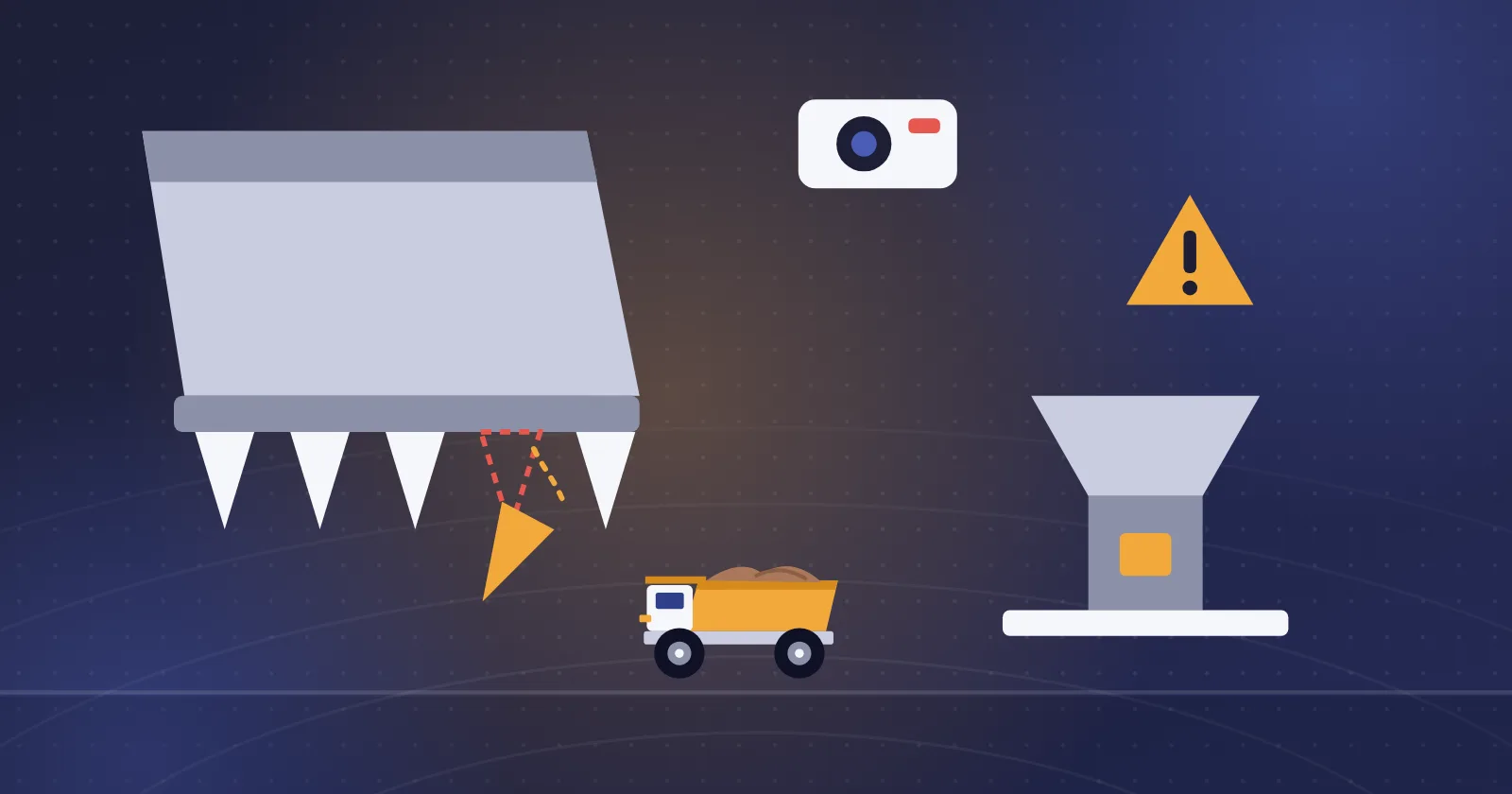
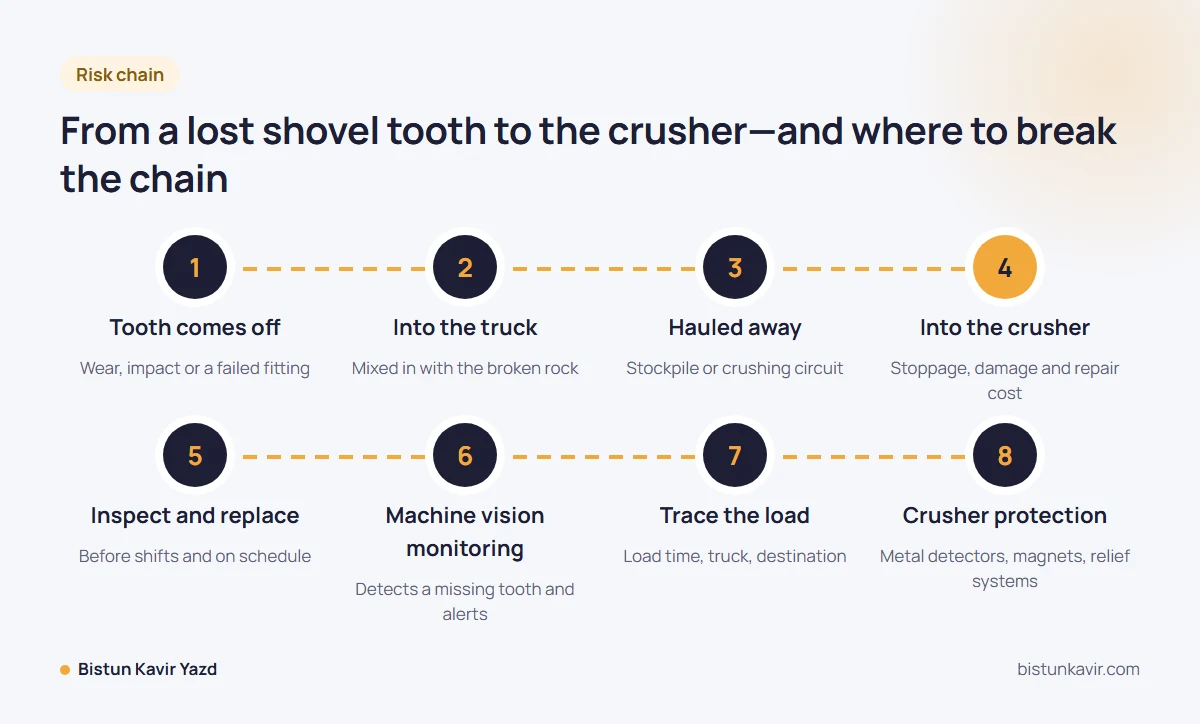
If a tooth breaks or comes loose from its mounting, it can end up in a dump truck with the excavated material and travel all the way to the dump point or crusher.
When that happens, the cost is not limited to replacing one tooth. A piece of steel entering the crushing equipment can stop operations, damage crusher components and lead to repair costs.
That is why monitoring for lost shovel teeth is an important part of managing risk in excavation and crushing equipment.
What is a shovel tooth and what does it do?
A shovel tooth, or bucket tooth, is part of the ground engaging tools (GET) mounted on the front edge of the bucket.
Its main job is to help the bucket penetrate the material and to protect parts of the bucket lip from wear and impact.
In open-pit mines, shovels face harsh working conditions when loading iron ore, other minerals and waste.
Constant contact with hard rock, high forces and gradual wear can all affect the service life of the teeth and their fittings.
Because the tooth is in direct contact with the excavated material, its failure or loss can affect not only the shovel but other parts of the mine's production process as well.
Why do shovel teeth break or come off the bucket?
A broken or lost tooth can be the result of one factor or a combination of several.
Gradual wear
The shovel tooth is a consumable part that wears down through constant contact with the material.
As it gets thinner or changes shape, its ability to withstand operating forces may decrease.
If inspection and replacement are not done on time, the likelihood of failure goes up.
Excessive impact and force
Hitting hard rock or applying unusual forces while loading can put significant stress on the tooth and its fittings.
How severe these stresses are depends on the equipment specifications, the material of the part and the operating conditions.
Problems with the fittings
Sometimes the problem is not the tooth itself but the retaining components or fittings that hold it.
Wear, incorrect installation or damage to the fittings can cause the tooth to come off the bucket.
Choosing the wrong part
The tooth must match the shovel model, bucket type and the mine's geological and operating conditions.
Using the wrong part can cause abnormal wear or early failure.
What happens after a shovel tooth falls off?
The main danger arises when a lost tooth is not detected in time.
Imagine that, during loading, one of the bucket teeth comes loose and ends up among the broken rock.
If neither the operator nor a monitoring system notices, the material—along with the piece of steel—goes into the dump truck.
The truck carries the load to the dump point, and if the load is sent to the crushing circuit, the steel part may enter the crusher with the material.
Uncrushable metal entering a crusher is known as tramp metal.
Depending on the crusher type, the size of the part, feed conditions and protective equipment, this can stop the machine, trigger protective systems or cause mechanical damage.
The gap between a tooth falling off and a problem at the crusher may therefore span several operational stages—each of which offers a chance to detect the problem and stop it going further.
What damage can a shovel tooth cause in a crusher?
Damage to internal crusher components
A crusher is designed to break specific materials. A hard, uncrushable piece of steel can put abnormal forces on the equipment.
Depending on the crusher type, these forces may damage crushing components, wear parts or other mechanical sections.
Some crushers do have relief or protection systems against uncrushable objects. How well they work depends on their design, maintenance condition and the circumstances of the incident.
Unplanned production stoppage
If the metal part jams in the machine or needs to be inspected and removed, the crusher may have to stop.
The stoppage can also affect processes upstream and downstream of the crusher.
For example, reduced crusher intake capacity may cause dump trucks to queue at the dump point.
Higher repair and maintenance costs
If damage occurs, the cost may include technical inspection, replacement parts, maintenance labour, support equipment and production downtime.
These costs depend on the type of incident, the crusher's specifications and the severity of the damage, so no fixed figure applies to every mine.
Risk to personnel
Removing metal parts jammed in crushing equipment may require specialised maintenance work.
Such work must follow safety procedures, energy isolation (lockout) and equipment maintenance requirements.
Entering the equipment area without following safe procedures can create serious hazards.
How do you calculate the hidden cost of a lost shovel tooth?
To estimate the economic impact of an incident, the price of a replacement part is not enough.
The real cost may be made up of several elements:
Direct cost: replacing the tooth, repairing damaged parts and maintenance labour.
Downtime cost: the economic value of production lost or delayed while the equipment was stopped.
Knock-on operating costs: the effect of the stoppage on the haul fleet, fuel consumption, the maintenance schedule and other dependent processes.
For example, if tramp metal stops the crusher for two hours, the operations manager should check how much of the planned production capacity was not achieved in those two hours.
Not all lost capacity necessarily means lost sales, however, since some production may be made up later or covered from stockpile inventory.
Suggested formula for assessing the cost of an incident:
Total incident cost = repair and parts cost + recovery operation cost + economic value of unrecoverable production + other attributable direct costs
Care must be taken not to count any cost twice.
How to prevent shovel teeth from falling off
Regular inspection of teeth and fittings
One basic measure is to check the condition of the teeth before work starts and at intervals set by the maintenance plan.
The inspection should cover wear, visible cracks, fittings and any signs of unusual damage.
Timely replacement of worn parts
Teeth should be replaced according to the manufacturer's instructions, actual mine conditions and inspection results.
Postponing the replacement of parts that have reached their wear limits can increase the chance of failure during operation.
Training shovel operators
Operators should know the signs of tooth damage and how to report anything suspicious.
Correct loading technique and avoiding unusual forces can also help reduce damage to the bucket assembly.
Protective equipment in the crushing circuit
Depending on the plant design, various kinds of equipment are used to detect or handle foreign metal objects along the conveying and crushing route.
These may include industrial metal detectors, magnets, crusher protection systems and other suitable methods.
How effective each method is depends on the size, material and position of the part and the design of the circuit.
The role of machine vision in detecting lost shovel teeth
Manual inspection matters for spotting tooth damage, but it can be hard to notice immediately when a tooth comes off during operation.
In these situations, camera-based monitoring systems that use machine vision can play a complementary role.
These systems capture images of the bucket and analyse the condition of the teeth to detect unusual changes or a missing part.
In a monitoring system suited to the mine's conditions, the workflow can include imaging the bucket, analysing the state of the teeth, identifying a suspicious change and alerting the operator or control room.
The aim is to increase the chance of detecting a failure early, so that action can be taken before a suspect load moves on to the next stages.
Machine vision systems also have limitations, though. Dust, poor lighting, teeth covered by material, camera angle and image quality can all affect detection accuracy.
For that reason, a monitoring system should not be seen as a complete replacement for technical inspection or crusher protection equipment.
What should be done when a lost shovel tooth is detected?
When an alert is received, the shovel and the related operation should first be checked in line with the mine's safety procedures.
If the loss is confirmed, the likely location of the incident and any suspect loads need to be identified.
Using loading times, truck IDs and load destinations, it is possible to work out which loads may have been affected.
Operations, maintenance and HSE staff then need to decide on stopping work, isolating or inspecting the suspect load and making the equipment safe.
Carrying out such a process requires a clearly defined communication procedure between the shovel operator, the dispatch centre, the crusher supervisor and the maintenance team.
What value does a shovel tooth monitoring system bring to a mine?
The main value of shovel tooth monitoring is that it makes early detection possible for a failure with potentially far-reaching consequences.
If a lost part is detected in time, the mine has more opportunity to assess the situation and prevent the part from moving on to the next stages.
This can help reduce the risk of unplanned equipment stoppages, improve operational reliability and better manage incidents involving tramp metal.
Bistun Kavir Yazd offers a shovel tooth loss monitoring system (Bucket Tooth Monitoring) as part of its portfolio of equipment monitoring and mining operations safety products.
The aim of this kind of system is to help detect a lost tooth and provide the information needed for an operational response.
Coverage, detection accuracy and how alerts are issued should be assessed for the actual conditions at each mine.
Conclusion
A shovel tooth may look like a small part compared with large excavation and crushing equipment, but its failure or loss can have consequences far beyond the cost of a replacement.
A lost tooth entering the haulage route and the crusher can stop operations, lead to repair costs and create safety risks.
Regular inspection, timely replacement, operator training and protective equipment are essential to reducing this risk.
Machine vision monitoring technology can also be used as a complementary layer for detecting failures early.
To discuss using a shovel tooth monitoring system at your mine, talk to the specialists at Bistun Kavir Yazd.