
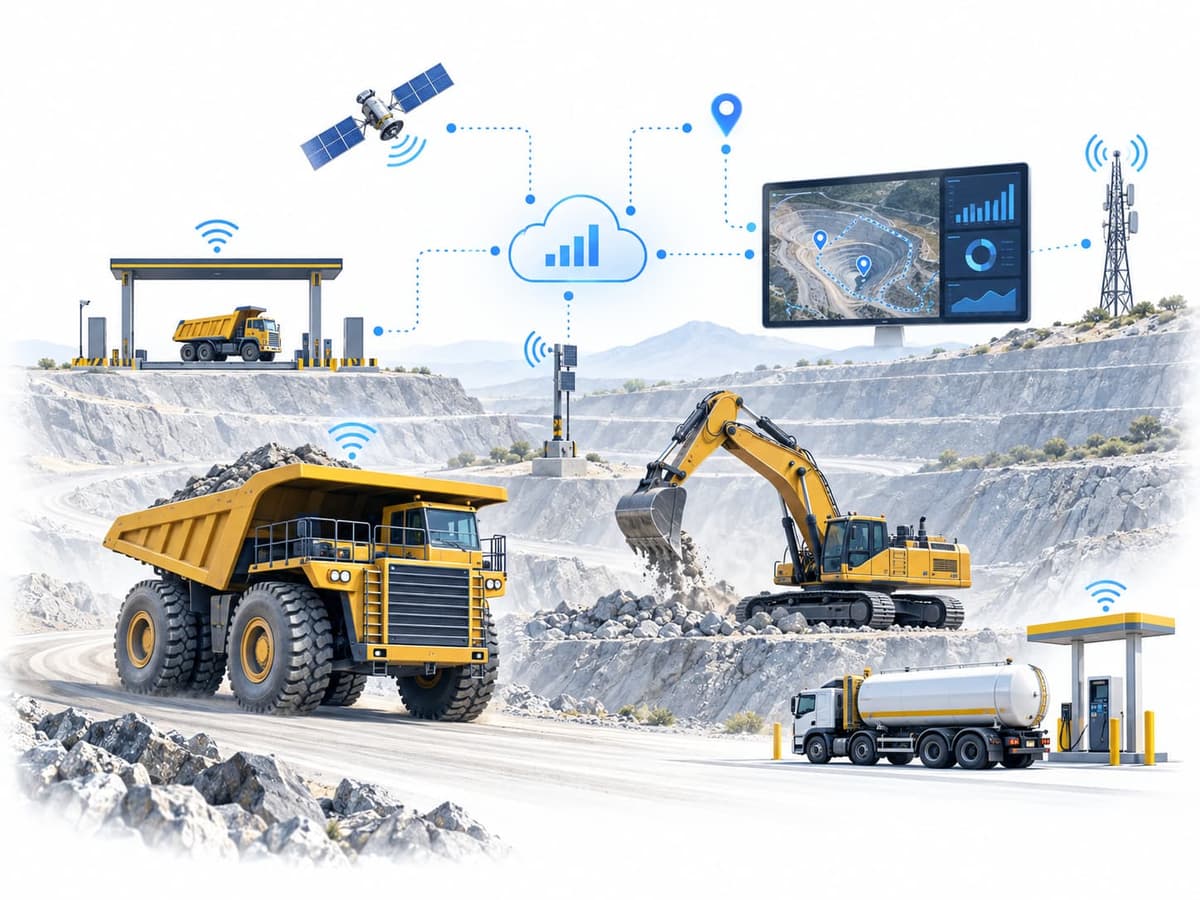
- Engine parameters
- Cooling and hydraulics
- Power transmission
- Fault and event codes
- Trend analysis
- Condition-based maintenance
Machinery failures don’t always start suddenly
Many technical issues are noticed only when the operator reports the problem, an alert appears on the display, or the equipment drops out of service. But gradual changes in engine temperature, system pressure, error recurrence, or the performance pattern of certain components may appear in machine data well before that.
A stoppage of a key machine doesn’t just incur repair costs; it also affects fleet availability, the hauling and production schedule, and the allocation of replacement equipment. So machinery health monitoring is not only a maintenance-department tool.
With unified data you can
- Separate recurring events from isolated faults
- Prioritize machines needing inspection
- Base maintenance decisions on history, not a single momentary alert
What is VHMS and what does it do?
VHMS stands for Vehicle Health Monitoring System. This solution receives data on equipment technical condition from accessible sources and turns it into information that can be viewed, compared, and tracked, answering the question: “What is the technical condition of each machine, and which signs need inspection?”
Depending on the machine’s brand and model, data may come from the electronic control unit (ECU), controllers, installed sensors, the CAN network, or telematics equipment. The type and number of displayable parameters are not the same for all machines and are determined during technical assessment.
Tracking, VPMS, and VHMS
- Tracking asks: “Where is the machine?”
- VPMS asks: “How is the machine performing?”
- VHMS asks: “What is the machine’s technical condition?”
From machine data to maintenance decision
The quality of this process depends on data acquisition accuracy, sampling frequency, and the project’s communication architecture.
- 1
Authorized data acquisition
Accessible data is received from the ECU, controllers, or sensors.
- 2
Transmission and structuring
Information is transmitted from the communication layer to the system and structured.
- 3
Display and history
Data is shown on the dashboard, in parameter history, and on the events page.
- 4
Thresholds and rules
Changes needing inspection are identified based on defined rules.
- 5
Technical team decision
Inspection, troubleshooting, or repair action is carried out with expert judgment.
What information does VHMS monitor?
The types of parameters available depend on the equipment’s actual capabilities.
Engine
Engine speed, temperature, related pressures, operating status, and electronic faults, especially compared with that machine’s own history.
Cooling system
Coolant temperature and related alerts.
Hydraulic system
Where compatible sensors or controllers are accessible: pressure, temperature, and technical events.
Power transmission
Parameters and events recorded by the machine controller for condition analysis.
Electrical system
Voltage and some electrical alerts, depending on the machine model.
Fault and event codes
Logging of Fault Codes and Event Codes along with the machine, time of occurrence, number of recurrences, and event status.
The current status isn’t the only thing that matters; see the trend of changes
Trend monitoring
A component’s temperature may still be within the allowed range but trending upward over several shifts. Trend analysis lets you compare today’s condition with previous days, after a repair, or with similar equipment.
Centralized fault management
Alerts that stay on the machine display do not build a coherent picture. VHMS centralizes retrievable fault codes with each machine's history, so frequently recurring events and machines with active alerts stand out.
Example: recurring cooling alert
A high coolant temperature alert logged repeatedly on one dump truck within a single shift is an event that needs review. The specialist first checks data validity and operating conditions, then decides on a technical action.
Note: An unusual change does not necessarily mean a failure; results must be interpreted against operating conditions and expert assessment. Alert severity and priority are set with input from the project's specialists.
Moving toward condition-based maintenance
VHMS can be one of the data infrastructure components of this approach, but on its own it is not a definitive failure-prediction system or a replacement for computerized maintenance management software (CMMS).
Reactive maintenance
Action usually begins after a failure.
Preventive maintenance
Service is planned by time or operating hours.
Condition-based maintenance
Actual equipment health data also plays a role in maintenance decisions.
What value does VHMS bring to a mine?
Continuous monitoring of technical parameters may increase the chance to investigate some abnormal conditions before serious stoppages. It can help reduce reliance on reactive maintenance alone, prioritize inspections, plan maintenance resources better, and potentially improve machine availability. The actual impact should be measured against pre- and post-deployment indicators.
VHMS complements operator reports with machine data. A technician's experience and field inspection remain essential, but with parameter history and fault codes, condition analysis goes beyond verbal reports and separate forms.
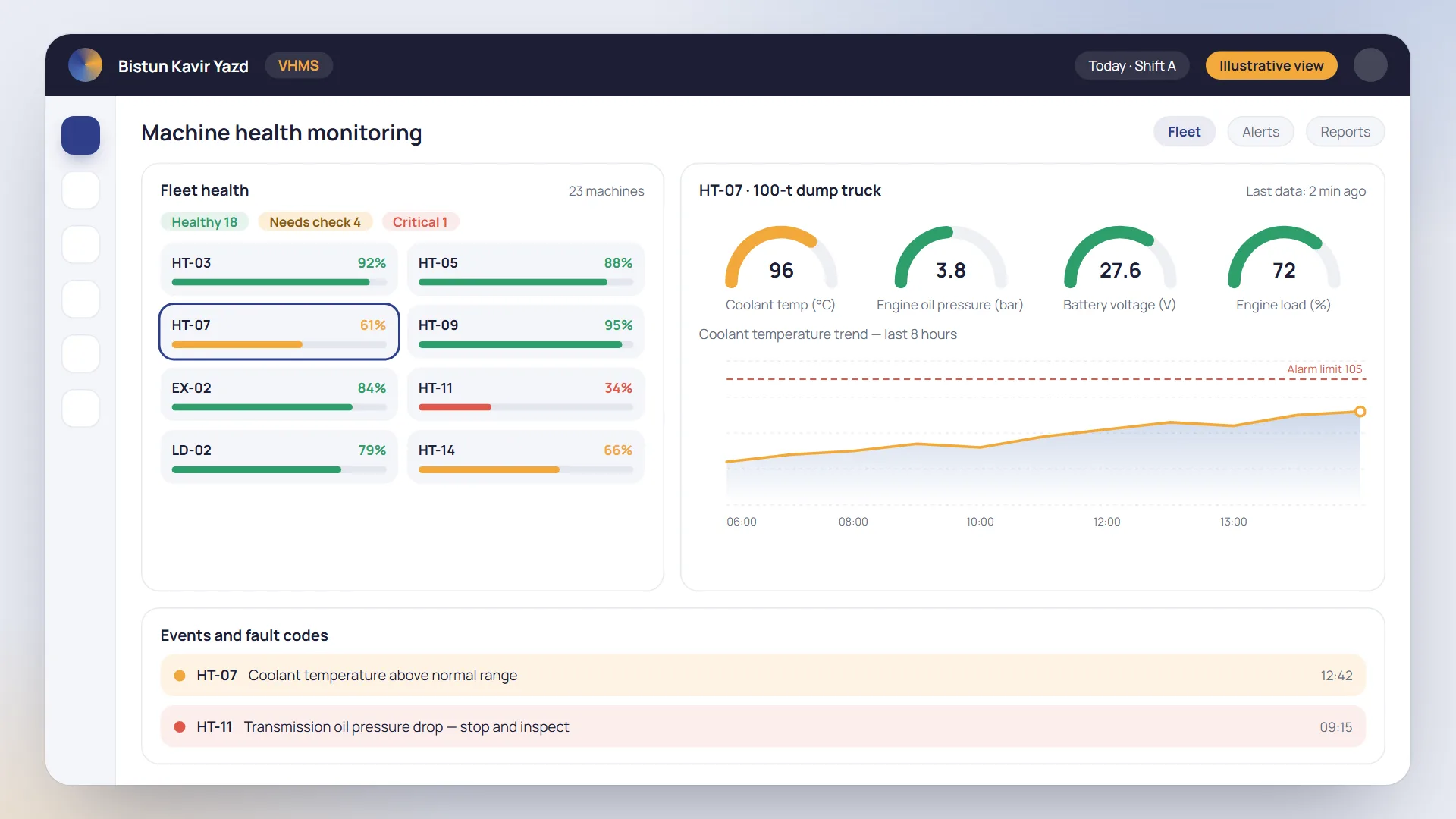
Fleet health dashboard
- Number of monitored machines
- Active events and priority alerts
- Operating hours and technical parameter trends
- Event history for each machine
- Engine temperature trend alongside related fault times
VHMS applications in mining machinery
In mining projects, machines come from different brands, models and years of manufacture; the ECU type, protocols and OEM access restrictions determine what data can be retrieved.
Haulage fleet
Dump trucks, focusing on engine, cooling and power transmission parameters.
Loading machinery
Shovels, excavators and loaders, where hydraulic and engine data matter most.
Support equipment
Bulldozers, graders and other mining equipment, based on the actual structure of each machine.
Multi-brand fleets
A centralized dashboard is possible, but the data retrieval method and level of information differ by brand and are determined in the initial assessment.
VHMS deployment steps at a mine
- 1
Understand the fleet and monitoring goals
Record brand, model, year of manufacture and number of machines, and discuss priorities with maintenance and operations.
- 2
Assess data sources and architecture
Review ECUs, controllers, the CAN network, sensors and limitations; and design data collection, transmission and display.
- 3
Pilot and validation
Test on a limited group of machines and evaluate parameter accuracy, connectivity, faults and alerting.
- 4
Deployment, training and improvement
Roll out to the target fleet, train users, and review alert thresholds as data history grows.
Which departments is VHMS for?
Maintenance manager
An overview of fleet health and equipment that needs review.
Maintenance and reliability engineers
Use fault history and parameter trends for failure analysis.
Operations manager
Review technical condition alongside the causes of stoppages or performance drops.
Mine manager
An overall picture of critical equipment status, availability and operational risks.
IT and smart-mining unit
Assess the data infrastructure and integration with the organization's other systems.
VHMS alongside other systems
With health data alongside Bitatracker, VPMS and Bismart, a drop in an asset's performance can be examined in relation to operating conditions and its technical signs, subject to infrastructure, access permissions and technical compatibility.
VHMS frequently asked questions
Does VHMS predict machine failure?
VHMS reveals abnormal conditions and measurable changes; failure prediction depends on sufficient data, a valid analytical model and equipment specifications, and is not a generally guaranteed capability.
Is the machine's fault code displayed in the system?
If the fault code can be retrieved and interpreted from the machine's ECU or controller, its logging and display are assessed within the project architecture.
Can VHMS be deployed on older machinery?
Some older equipment offers limited digital data; feasibility is determined in the technical assessment based on its electronics, sensors and supplementary equipment.
Can it be used with Caterpillar and Komatsu?
Data access is assessed separately for each brand, model and machine generation, and uniform compatibility across all models cannot be assumed.
Does VHMS replace maintenance software?
No. It provides machine health data for maintenance decisions and, where possible, complements the maintenance management system.
Is data displayed in real time?
Retrieval and display frequency depend on the data source, connectivity conditions and the chosen architecture.
How is the cost of deploying VHMS determined?
The number and type of machines, data access, required equipment, communication network, number of parameters and dashboard features.

Your mine could be our next project
Our consultants are ready to answer every question on your path to a smarter mine.
Yazd, Motahari St., Eqbal Science & Technology Park, Al-Zahra Building, DIACO Mining Technology Development Center
Request an initial mine review
Three short steps — it takes less than a minute.
Step 1 of 3 · Contact details