
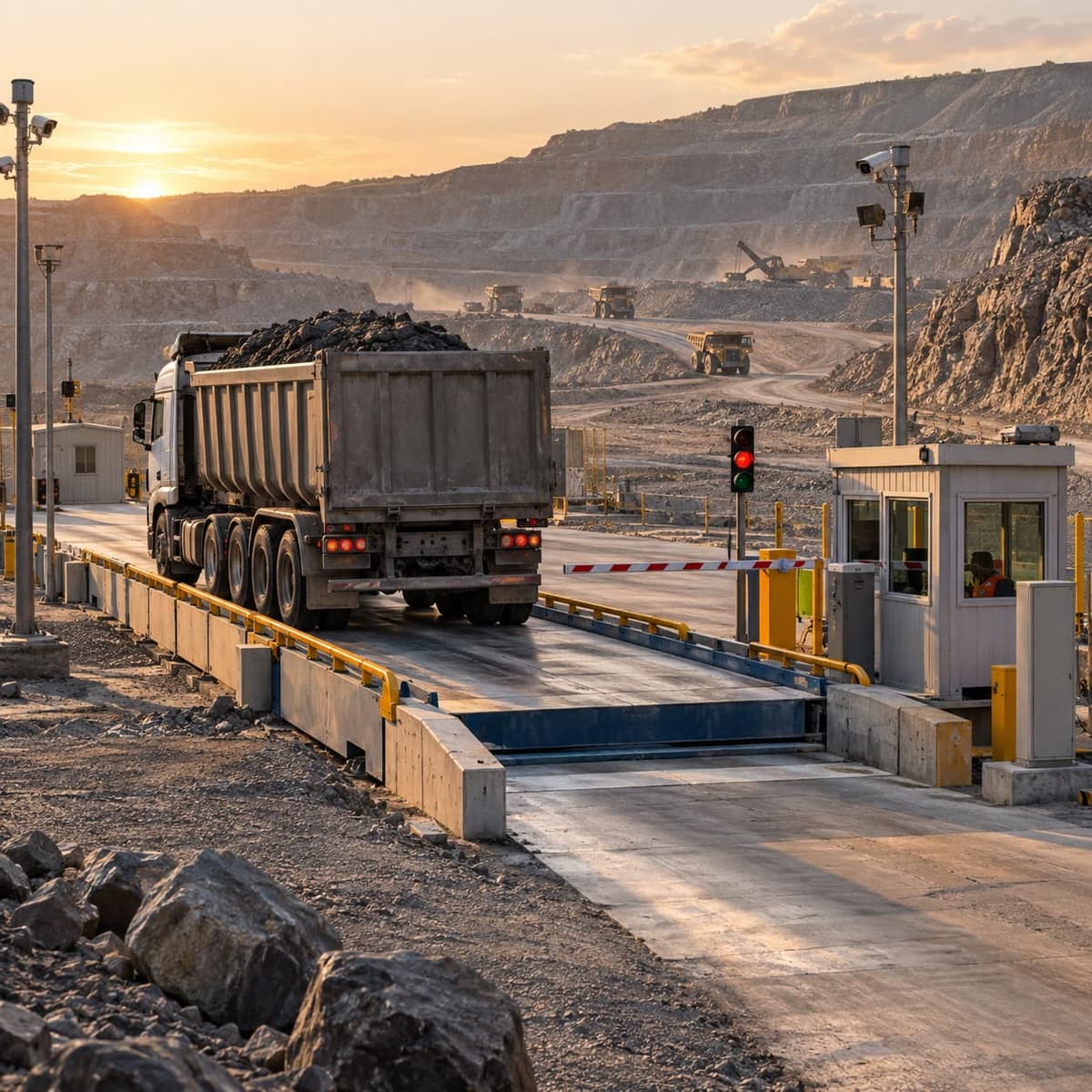
- Automatic weighing
- Vehicle identification
- Traffic control
- Tonnage logging
- Transaction tracking
- Management reporting
Why does traditional weighbridge management become an operational bottleneck?
The weighbridge sits on the path of mineral inflow and outflow, and any error or delay there not only slows operations but also affects the quality of management and financial reports.
The goal of smart automation is not to remove human oversight; it is to record events in an orderly way, reduce recurring errors and provide reviewable evidence for decision-making.
Key challenges
- Truck queues and stoppages, and longer haul cycle times
- Manual plate entry and linking weight to the wrong vehicle
- Mismatch between empty and loaded weights
- Inadequate entry and exit control
- Scattered data across multiple weighbridges and shifts
- No clear record of user actions
Sample two-stage weighing scenario
The sequence of steps can vary with the traffic route, load type and site requirements.
- 1
Defining the haul assignment
Vehicle, contractor, material type, origin or destination and permits.
- 2
Vehicle identification
License plate recognition or another approved method at the control point.
- 3
Traffic permit check
Checking vehicle status and clearance to pass under project rules.
- 4
Recording empty weight
After correct positioning and confirmation that the weight is valid.
- 5
Loading
Going to the loading area and linking load information, if available.
- 6
Recording loaded weight
The second weight, together with time, vehicle ID and transaction.
- 7
Calculating net weight
The difference between loaded and empty weight, checked against defined rules.
- 8
Issuing receipt and confirmation
A ticket with valid details, with exceptions flagged.
- 9
Recording exit and closing the cycle
Exit time and final status for reporting and reconciliation.
Core capabilities of the smart mine weighing system
Vehicle identification and entry control
Linking weight to the correct vehicle identity via license plate recognition, identification tags or fleet data; connecting to barriers and signal lights depends on hardware compatibility.
Automatic weight capture from the indicator
If the indicator is supported and the protocol confirmed, weight is captured without manual entry, and weight stability, time and weighbridge ID are checked.
Linking empty weight, loaded weight and load to one transaction
A unique ID for each weighing so that weights, vehicle, driver, contractor, shift, material and destination are all linked.
Managing multiple weighbridges and routes
Centralized data collection by station, shift and route; for a bidirectional weighbridge, equipment placement is designed separately for each direction.
Image evidence and weighing receipt
Linking entry, on-scale and license plate images to the transaction record, and issuing a ticket with the fields the mine requires.
User roles and action history
Recording the user, time, type of change and reason for correcting or voiding a transaction (Audit Trail) for review and audit.
Control rules and alerts
Weight out of range, repeat visits, missing first weight, vehicle mismatch or incomplete transaction; an alert does not prove a violation.
Turn weighbridge data into operational KPIs
If a daily report shows 12,450 tonnes hauled, the total alone is not enough. It should be clear how many trips, which vehicles, which shift, which contractor and which destination the figure was recorded for.
- Total tonnage
- Sum of the net weight of valid loads in the period.
- Net weight
- Difference between loaded and empty weight in each valid cycle.
- Transactions per shift
- Number of completed weighings or cycles.
- Average payload per trip
- Recorded tonnage divided by the number of loaded trips.
- Tonnage per contractor
- Each contractor's share of recorded tonnage.
- Tonnage per destination or material
- Breakdown report based on recorded destination and material.
- Average weighing time
- Interval between the start and end events of the process.
- Queue time
- Only available when queue entry and service start times are recorded.
- Incomplete or corrected transactions
- A data and process quality monitoring indicator.
Note: On multi-contractor sites, linking each transaction to a contractor and machine shows trips, tonnage, average payload and destinations, and supports initial reconciliation against progress statements; it does not replace contractual controls or financial documents.
Smart weighing use cases in mining
Plant entry and exit weighbridge
Identification and weighing before loading or unloading, with the second weight linked to the same record; inbound and outbound material reports by material or origin.
Two or more weighbridges on site
Consolidate stations in one dashboard to compare operation volumes and events; clock synchronization and unique IDs are important.
Contractor fleet control
Link vehicle IDs to contractors and report trips and tonnage periodically; vehicles without valid authorization are flagged according to the client's rules.
Weight and transaction discrepancy review
Cycles without a valid empty weight, or with a weight outside the expected range, are shown for review; images and history help identify the cause.
Connecting the weighing system to other mining systems
Connection to ERP, warehouse, finance, logistics, SCADA or enterprise APIs is assessed for feasibility after reviewing the documentation and technical access.
Mining weighing management dashboard
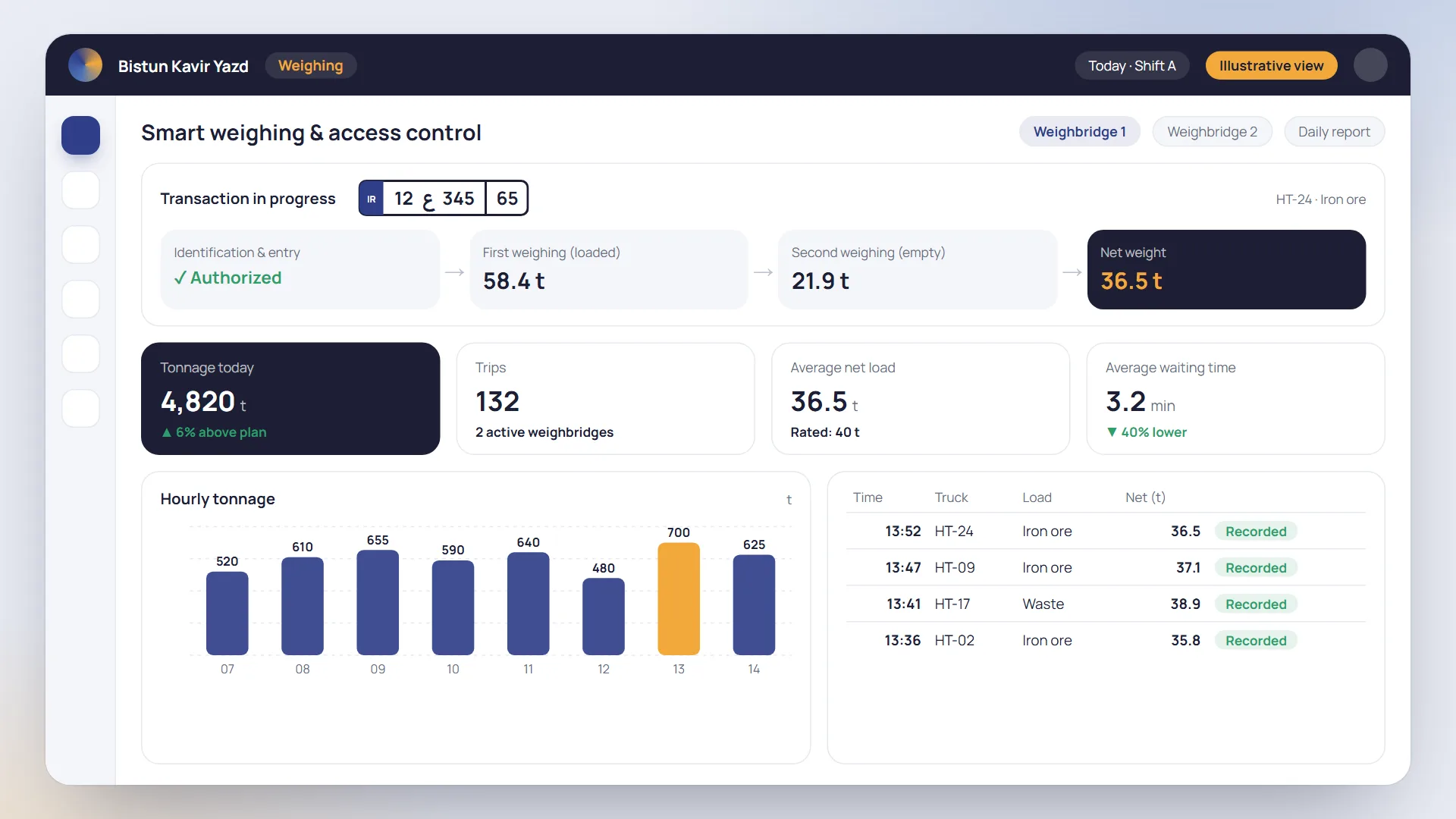
The dashboard shows weighbridge status, daily tonnage, transaction counts, weight history, shift performance, high-traffic vehicles, contractor tonnage and discrepancies that need review. Viewing multiple stations in one central environment speeds up follow-up and reporting.
Requirements for deployment on an existing weighbridge
- Weighbridge: capacity, structure, calibration and ramp
- Weight indicator: model, ports and protocol
- Vehicle identification and traffic control: camera, barrier, sensor
- Existing computer and software, API and ticket printer
- Network, power and UPS
- Information security and time synchronization
- Operating structure and weighing method
Note: During a network outage, continued operation, local storage, synchronization and prevention of duplicate records must be defined in the design and tested; these capabilities are not assumed without reviewing the installation architecture.
Implementation steps, from initial site visit to operation
- 1
Understand the existing process
Site visit, equipment, forms and vehicle flow.
- 2
Design the operating scenario
Identification points, traffic route, operator role and exceptions.
- 3
Check equipment compatibility
Test weight capture, vehicle identification and communications.
- 4
Installation and configuration
Define stations, users, contractors and rules.
- 5
Operational testing
Empty and loaded weighing, ticket, discrepancy, and communication loss and recovery.
- 6
Training and handover
Operator training, documentation and support level.
- 7
KPI monitoring
Baseline and post-deployment performance comparison.
FAQ about smart mining weighing
Can the system be installed on an existing weighbridge?
In many projects the existing weighbridge can be assessed for reuse; the final decision depends on the weight indicator model, the communication interface and the condition of the equipment.
Is vehicle identification only through a plate reader?
No. A plate reader is one option, and other methods are designed depending on the environment and the expected accuracy.
How are empty and loaded weights linked to a machine?
Through the vehicle ID and a unique weighing-cycle ID, together with matching rules and error control.
Is one camera enough for a two-way weighbridge?
Not necessarily. The number and placement of cameras depend on routes, distance, lighting and plate angle.
Can multiple weighbridges be managed?
Yes; a central dashboard for multiple weighing points, with a consistent communication layer and data structure.
What happens during a network outage?
It depends on the project architecture; temporary storage, continued weighing and synchronization are defined and tested before operation.
Is data tampering detected automatically?
Control rules and event history highlight suspicious cases; the final determination requires human review and documentation.
Does it connect to Bismart and the fuel system?
The possibility and scope of integration are confirmed after reviewing the version, API and data structure.
How long does implementation take?
It depends on the number of stations, the readiness of equipment and network, the scope of integration and operational testing.

Your mine could be our next project
Our consultants are ready to answer every question on your path to a smarter mine.
Yazd, Motahari St., Eqbal Science & Technology Park, Al-Zahra Building, DIACO Mining Technology Development Center
Request an initial mine review
Three short steps — it takes less than a minute.
Step 1 of 3 · Contact details