

- Tank inventory monitoring
- Digital refueling records
- Contractor quota management
- Consumption analysis
- Discrepancy detection
Why is traditional fuel management not enough at a mine?
High diesel consumption, scattered fueling points, a variety of machinery and many contractors make fuel control complex. When data is kept in ledgers, Excel files and disconnected systems, getting an accurate picture of inventory and consumption takes time.
The system does not promise to eliminate discrepancies or violations entirely; its goal is to create organized data and control tools for detecting, reviewing and following up on events.
Common challenges
- Fuel delivered without a definite link to a machine or recipient
- Differences between measured and calculated tank inventory
- Manual recording of contractor quotas and balances
- No comparison of consumption with operating hours and haul volume
- Late detection of unexpected tank level drops
- Scattered documents and unclear history
Every liter of fuel, a clear information trail
Tailored to each mine’s actual equipment and process, the system connects the eight core steps of the fuel chain.
- 1
Fuel receipt logging
Shipment details, receipt time, quantity and receiving location.
- 2
Tank monitoring
Receiving or recording stock levels and fuel-level trends.
- 3
Outflow measurement
Recording the delivered quantity via flowmeter or a compatible source.
- 4
Recipient identification
Linking each transaction to a machine, contractor or consuming unit.
- 5
Transaction logging
Time, volume, tank, operator and required identifiers.
- 6
Data reconciliation
Comparing inflows, outflows and tank inventory.
- 7
Discrepancy review
Flagging variances and unusual patterns.
- 8
Management reporting
Status of tanks, machines, contractors and indicators.
Core capabilities of the fuel management system
Monitoring tank inventory and changes
Current stock, level trends, receipt and delivery records, and potential variances; accuracy depends on tank calibration, sensor reliability and data quality.
Digital logging of refueling transactions
Each refueling becomes a transaction recording the machine ID, contractor, time, volume, tank, location and the user who logged it.
Machine identification and delivery control
Matching machine ID with GPS, license plate recognition or other project-approved methods; each method requires assessing data confidence.
Contractor quota management
Approved quota, recorded consumption, balance and machine transactions for each contractor in a single view.
Identifying and following up on discrepancies
An inventory variance is not necessarily a violation; it may stem from measurement error, temperature, calibration or recording. The system provides the data needed for root-cause analysis.
Reporting and history
Trend analysis by machine, contractor, tank, shift or time period, with user activity records for internal audit.
In real-world calculations, the unit of measurement, level-measurement method, temperature correction, tank calibration and time period must be consistent.
From logging liters to analyzing productivity
Two dump trucks that each took 1,200 liters of fuel do not necessarily have the same productivity; they may differ in tonnage, route length or idle time. Consumption analysis should be done alongside operational indicators.
- Total fuel consumption
- Volume recorded over the selected period.
- Consumption per working hour
- Liters per operating hour, based on valid working-hour data.
- Fuel per ton
- Ratio of fuel to the related hauled or produced tonnage.
- Consumption per trip
- Comparison across similar haul cycles.
- Idle fuel
- Based on reliable consumption and engine-status data.
- Tank variance
- Difference between actual and calculated inventory.
- Contractor consumption and remaining quota
- Delivered volume and quota status.
- Number and frequency of refuelings
- Transactions per machine or period.
Note: Unusual consumption does not always indicate a violation; it may relate to idle time, grade and route length, road conditions, load, engine condition, operator practice or recording differences. Not all indicators can be calculated the same way in every project.
Who is the management dashboard for?
Mine and operations manager
Overall consumption trend, tank status, contractor comparison and the link between consumption and operational performance.
Fuel and warehouse officer
Inventory, receipts and deliveries, transaction records, tank balances and discrepancies.
Contracts and finance
Volume delivered to contractors, remaining quota and transaction documentation.
Technical and maintenance unit
Comparing consumption patterns and referring unusual cases for technical review.
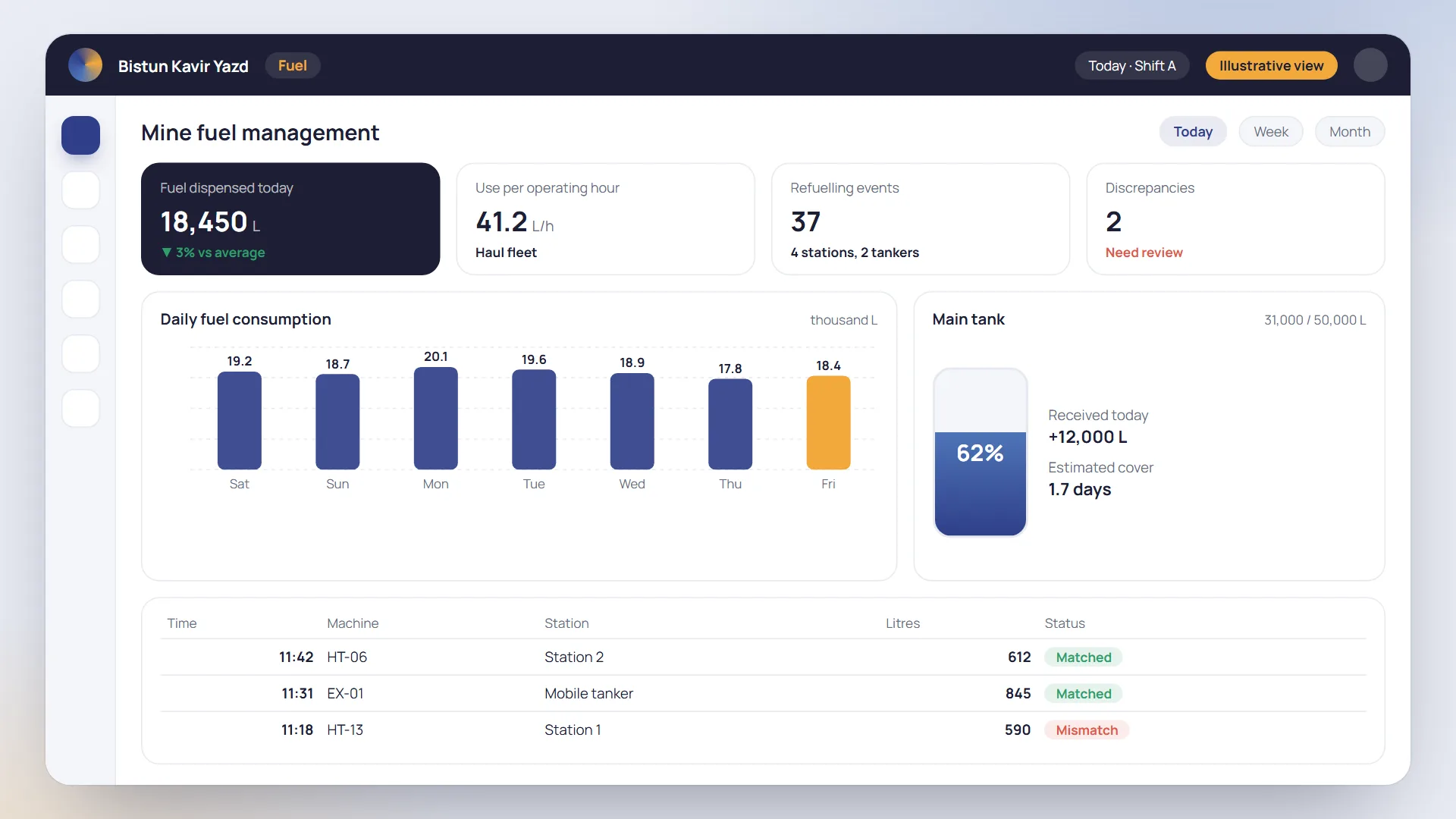
Integrating fuel management with mining systems
The management question evolves from “How many liters of fuel were used?” to “For how much work was this amount used, and why?”
Operational scenarios at the mine
Tank inventory variance at end of shift
Opening inventory, receipts, deliveries and closing inventory for the shift are compared, and variances outside the acceptable range are prioritized for review.
Controlling the mining contractor’s fuel
The contract manager sees the contractor’s quota, deliveries and balance, and pulls up their machine transactions for review.
Increased consumption of a dump truck
The increase is assessed alongside haul volume, shift, operating hours and stops, and, given sufficient data, the operational or technical cause is investigated.
Forecasting fuel supply needs
Consumption trends and tank balances help estimate the next period’s needs, but this does not guarantee shortages are avoided.
System installation and commissioning requirements
The final architecture depends on the number of tanks and fuel trucks, existing equipment, refueling locations, environmental conditions, network coverage and required data quality.
In locations with a fire or explosion hazard, electrical equipment and instrumentation must be selected and installed by a qualified specialist in accordance with the relevant safety requirements.
Items to review
- Tanks: number, capacity, calibration table
- Dispensing points: pumps and flowmeter connectivity
- Machines: ID and contractor affiliation
- Identification method and confidence level
- Communications, power and network outages
- Quota structure, transactions and user access
- Safety in fuel-handling environments
Fuel management system deployment stages
- 1
Understanding the current state
Fuel receiving, storage, distribution and recording process.
- 2
Identifying control points
Tanks, machines, stations and contractors.
- 3
Solution design
Required data, compatible equipment and integration.
- 4
Infrastructure preparation
Power, network, safety requirements and installation route.
- 5
Installation and configuration
Commissioning equipment and defining system entities.
- 6
Data accuracy testing
Reconciling sample transactions and adjusting settings.
- 7
Training and handover
Training users and defining responsibilities.
- 8
Baseline definition
Recording the initial state and agreeing on indicators.
Outcomes you can measure
After establishing a baseline and running the system steadily, the mine can evaluate consumption report preparation time, the number of transactions without a valid ID, discrepancy resolution time, inventory variance percentage and the accuracy of contractor quota data. The actual improvement depends on implementation quality and data-recording discipline; therefore, no specific percentage reduction is promised.
The system can be assessed for iron ore, copper and coal mines and other operations with diesel fleets, mining or hauling contractors, and multiple tanks or fueling points.
Post-deployment evaluation indicators
- Consumption report preparation time
- Transactions without a valid ID
- Discrepancy resolution time
- Inventory variance percentage
- Accuracy of contractor quota data
Frequently asked questions
What information does the system record?
Depending on the project design: tank inventory, receipts, delivered quantity, time, receiving machine, contractor, location and transaction ID.
Can it be installed on existing tanks?
After reviewing the tanks, inventory-measurement method, equipment and safety conditions, a solution is proposed for each location; installation on all tanks is not guaranteed in advance.
How is a machine identified during refueling?
Based on a defined ID and compatible sources such as GPS or license plate recognition; the final method depends on infrastructure and the operational process.
Is contractor quota management possible?
Yes; defining and tracking each contractor’s quota, recorded consumption, balance and transactions.
Is actual engine consumption calculated?
Recorded delivery is not necessarily equivalent to instantaneous engine consumption; calculating engine consumption or idle fuel requires specialized data and a defined calculation method.
Are discrepancies eliminated entirely?
No. The system is designed to record, analyze and follow up on variances; resolving them depends on measurement instruments, process and user follow-through.
Is there integration with Bismart, Bitatracker and the weighbridge?
Integration is designed within the project scope after reviewing interfaces, identifiers and data.
What happens if the network goes down?
It depends on the architecture and the equipment’s storage capability; offline logging and resending are specified in the technical plan.
How is the implementation cost determined?
Number of tanks, delivery points, existing equipment, machine identification method, integration scope and installation conditions.

Your mine could be our next project
Our consultants are ready to answer every question on your path to a smarter mine.
Yazd, Motahari St., Eqbal Science & Technology Park, Al-Zahra Building, DIACO Mining Technology Development Center
Request an initial mine review
Three short steps — it takes less than a minute.
Step 1 of 3 · Contact details