
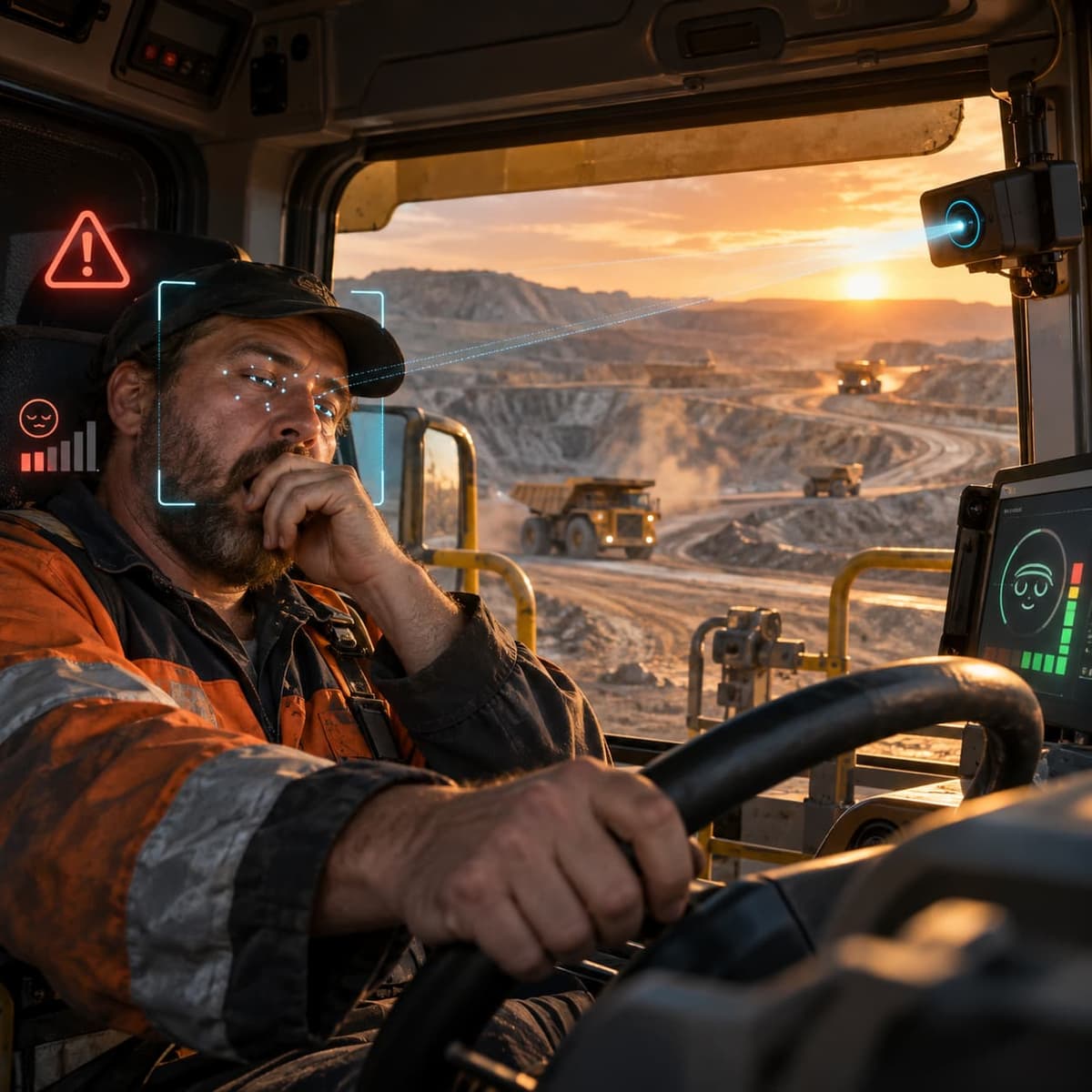
- In-cab monitoring
- Real-time alert
- Event logging
- HSE dashboard
- Safety trend analysis
Why does alertness monitoring matter in mining operations?
A dump truck may drive a similar route dozens of times in one shift. Repetition, changing light, vibration and working hours can set the stage for reduced attention. In such conditions, relying on occasional supervisor observation or post-incident reports is not enough to understand risk patterns.
How DMS helps
- Identifying early signs in the eyes, head and attention
- Alerting the driver directly in the cab
- Reviewing patterns across shifts, machines and areas
- Following up on corrective action, training and fatigue management
What is DMS and how does it work?
DMS stands for Driver Monitoring System; an in-cab camera captures the required image and algorithms analyze indicators of eye state, face, head direction and attention.
- 1
Image capture
Capturing the required driver data with a suitable cab camera.
- 2
Local analysis
Evaluating indicators on Edge-architecture processing hardware.
- 3
Event detection
Matching observed patterns against thresholds and settings.
- 4
Alerting
Audible alert or other supported in-cab methods.
- 5
Logging and transfer
Storing the event and sending permitted data to the management software.
- 6
Review and improvement
Analyzing the event in HSE and following up on corrective actions.
Cycle: Suggested cycle: detect ← alert ← log ← review ← corrective action ← measure result
Which indicators does the system assess?
Detection accuracy depends on camera angle, lighting and face coverage.
Eye closure and PERCLOS
An indicator based on the proportion of time the eyes are closed within a window; it can be one input to fatigue analysis, but it is not a medical diagnosis on its own.
Blinking, yawning and head posture
Blink patterns, frequent yawning and unusual changes in head direction or position, on supported equipment.
Gaze direction and distraction
Prolonged attention outside the expected working area; judged against the operator's actual tasks, since looking at a mirror or control equipment is not distraction.
Signs related to brief sleep
Some eye and head patterns coincide with a sharp drop in alertness, but the occurrence of “microsleep” is not certain in all conditions and must be tested in a pilot.
From detection to action
The first recipient of the alert is the driver. The alert type and level are set according to machine conditions, operational sensitivity, the false-alarm rate and approved HSE procedures.
Alert levels
Defined, short-term sign
Persistence or recurrence of the event
Designated events
Note: A DMS alert is not an order for the machine to stop suddenly; the safe response must be defined according to the mine's operating procedures and driver training.
HSE management dashboard: turning events into analysis
Depending on the deployed version's features and the data that can be retrieved, the dashboard gives authorized users an integrated view of fleet alerts and events.
Sample management question: do specific alerts increase toward the end of a shift? To answer correctly, the event rate must be interpreted alongside actual operating hours and the number of active machines.
On the dashboard
- Events by time, shift and machine
- Number and type of alerts and their trends
- Event recurrence and follow-up status
- Event details: time and machine ID
- Before-and-after comparison of corrective action
Key DMS monitoring indicators
- Events per shift
- Events logged during the shift, by type.
- Event rate per operating hour
- A fairer comparison of machines or shifts with different activity durations.
- Recurring alert rate
- Identifying recurrence patterns over defined periods.
- Time distribution of alerts
- Hours or days with a higher concentration of events.
- Event review time
- The interval from event logging to review by an authorized person.
- Corrective action status
- Logging follow-up, outcome and effectiveness review.
Note: An increase in the number of alerts does not always mean worse safety; changes in settings, the number of active devices or detection quality also affect the statistics.
From alert to fatigue management program
DMS delivers the most value when used alongside fatigue assessment, shift scheduling, adequate rest, training and safe reporting.
- 1
Review the evidence
- 2
Examine the event context
- 3
Non-punitive conversation with the driver
- 4
Define a proportionate action
- 5
Measure the trend after action
Designed for mining environments
DMS performance depends on hardware selection, camera placement and testing in real conditions; claiming identical performance in all cabs and lighting conditions without valid testing is not credible.
Daylight and night shift
Selecting a suitable camera and evaluating performance in darkness or changing light.
Vibration and dust
Stable installation, connector protection and compliance with environmental specifications.
Different cabs
Reviewing field of view, driver position and obstructions such as the steering wheel and glass.
Glasses and personal protective equipment
Assessing the effect of driver gear on detection quality.
Limited connectivity
Local processing and the event-transmission policy during network outages.
Edge processing, privacy and driver trust
In an edge-processing architecture, most of the analysis runs on the device itself, and the in-cab alert does not depend on a constant server connection; however, central transfer and display of events depend on the communication infrastructure. It must be clear what data stays only on the processing device, which events are stored, and what information is transmitted.
The goal of deployment is to manage safety risk, not unlimited surveillance or automatic use of every alert for disciplinary decisions. The data-use policy must be explained to drivers before operation begins.
Data protection principles
- A specific, authorized purpose for data collection
- Minimizing video data and retention period
- Separate access levels for safety, supervisor and system administrator
- Logging of access and changes
- Handling false alerts
- Compliance with regulations and contractual requirements
Which machinery can DMS be evaluated on?
Dump truck and haul truck
Long haul routes, night shifts and repeated trips.
Loaders and loading equipment
Allowing for frequent glances around the loading area.
Graders and bulldozers
Suitable camera positioning and performance in vibrating cabs.
Light vehicles and support
Drivers of vehicles traveling on mine roads.
Contractor fleets
By defining data ownership, review responsibility and access rights.
Where DMS fits in the smart mining ecosystem
Once compatibility and integration are confirmed, viewing driver, location, shift and operations data together helps review the context of an event; this connection is not a default part of every project.
Suggested DMS deployment stages at a mine
- 1
Safety needs assessment
Risks, fleet type, number of shifts and monitoring goals.
- 2
Cab and infrastructure survey
Camera position, power, communications, lighting and installation constraints.
- 3
Equipment selection and installation
Safe installation without obstructing the driver's view or performance.
- 4
Calibration
Adjusting angle, sensitivity and alert scenarios.
- 5
Operational pilot
Day and night testing, recording correct and false alerts.
- 6
Developing HSE procedures
Review owner, alert response, data protection and training.
- 7
Phased rollout
Deployment across more of the fleet after the pilot is accepted.
- 8
Results evaluation
Comparing indicators and refining settings at defined intervals.
Pilot evaluation: Before a wide installation, agree on pilot acceptance criteria: detection rate for defined events, false alerts, alert timing, performance at night and with glasses, device stability, the alert's effect on the driver and the quality of management reports.
Frequently asked questions
Does DMS detect drowsiness with certainty?
No. The system analyzes certain indicators related to reduced alertness based on imagery and algorithms; the result is not equivalent to a medical diagnosis or a guarantee of accident prevention.
Does the in-cab alert stay active if the internet is lost?
If the device has local processing and alerting, the alert does not depend on a constant connection. Transfer to the dashboard and synchronization depend on the architecture and equipment.
Does it work at night?
Depending on the camera and equipment, low-light operation is possible, but it must be evaluated in a real night-time pilot.
Can a driver wearing glasses be monitored?
Performance depends on the type of glasses, viewing angle and camera technology, and must be tested.
Are all driver images stored or transmitted?
Not necessarily. Storage and transmission depend on project settings, hardware capability and privacy policy, and are defined explicitly.
How does DMS differ from ADAS?
DMS monitors the driver's state; ADAS mainly monitors conditions around the vehicle. The two are complementary.
Are events connected to Bismart or Bitatracker?
If data interfaces are available and technical compatibility is confirmed, an integration can be designed.
Who should review the alerts?
This is defined in the mine's procedures; usually the HSE officer or an authorized supervisor with controlled access.
How is the DMS price determined?
A tailored estimate is provided after reviewing the machinery types, number of devices, software features, and installation and support requirements.

Your mine could be our next project
Our consultants are ready to answer every question on your path to a smarter mine.
Yazd, Motahari St., Eqbal Science & Technology Park, Al-Zahra Building, DIACO Mining Technology Development Center
Request an initial mine review
Three short steps — it takes less than a minute.
Step 1 of 3 · Contact details