
In many mining projects, work does not stop when the day shift ends. Haulage equipment, dump trucks and loading machines may run around the clock to keep the production plan on track. Night work, however, is one of the main factors behind fatigue and reduced alertness among mining equipment operators.
An operator who spends long hours at the wheel of a haul truck has to keep track of the haul road, road conditions, the distance to other machines and what is happening at the loading and dumping points—all at the same time. Even a brief lapse in concentration can raise the likelihood of an operational incident.
That is why fatigue management for mine operators is not only a matter of workforce health; it is part of the mine's safety programme, risk management and operational continuity.
Why is driver fatigue more dangerous on the night shift?
The human body follows a natural sleep–wake cycle known as the circadian rhythm. At night—especially from around midnight to the early morning—the body's natural drive to sleep increases.
Under these conditions, even operators with years of experience on mining equipment may lose concentration, react more slowly and make poorer decisions.
According to guidance from the US National Institute for Occupational Safety and Health (NIOSH), work-related fatigue can affect reaction time, attention, short-term memory and judgement.
This matters even more in a mine, where dump trucks and other heavy equipment operate on roads that may have steep grades, many bends, changing surfaces and limited sight lines.
Picture a haul truck operator approaching the dump point in the last hours of a night shift. If fatigue causes them to misjudge distance or speed, the risk of hitting equipment or leaving the road goes up.
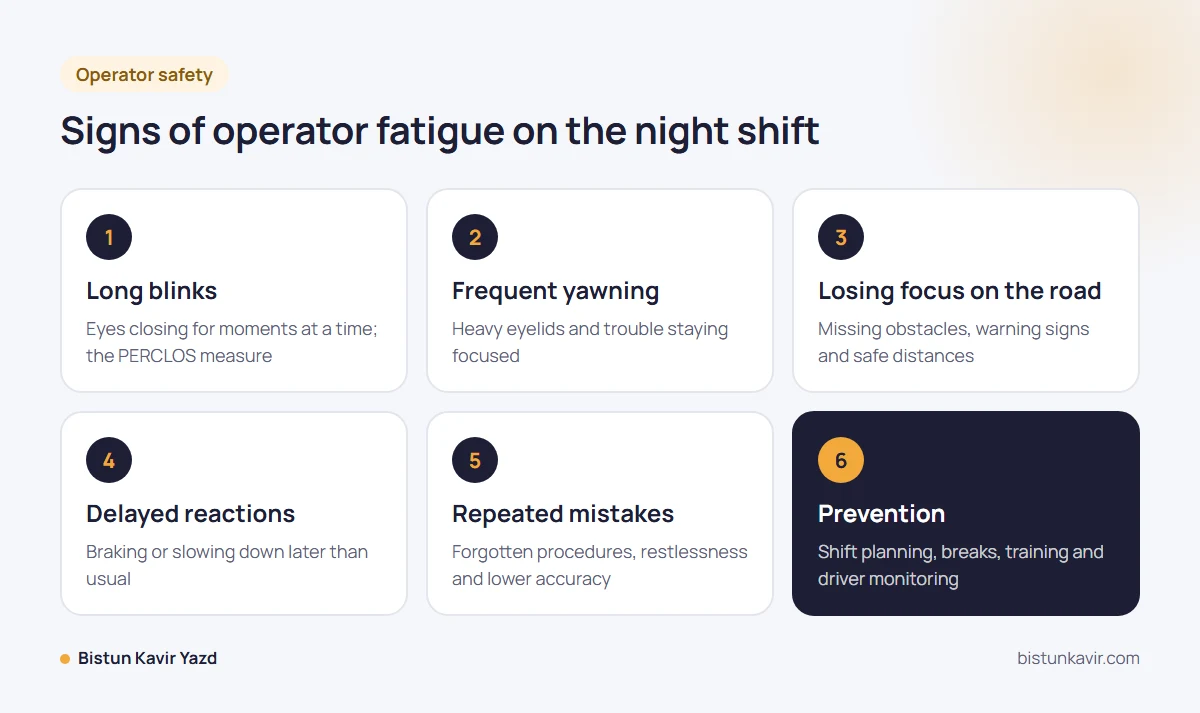
Key signs of fatigue and drowsiness in mine operators
Fatigue does not always begin with falling asleep at the wheel. In many cases, its early signs can be seen well before an incident happens.
1. Long blinks and eyes staying closed
One common sign of drowsiness is an increase in how long the eyelids stay closed. The operator may feel they closed their eyes for only a moment, but in a high-risk operating environment that short gap matters.
PERCLOS, which measures the proportion of time the eyelids are closed over a given period, is one of the methods used in research and in some drowsiness detection systems.
2. Frequent yawning and reduced alertness
Repeated yawning, heavy eyelids and difficulty staying focused can all point to growing fatigue.
Yawning alone, however, is not a definitive measure of drowsiness and should be assessed together with other signs and working conditions.
3. Reduced focus on the road
A tired operator may be slower to spot obstacles, notice warning signs, keep a safe following distance or follow changes in the route.
On mine haul roads shared by heavy equipment and light support vehicles, this can be dangerous.
4. Late reactions to unexpected situations
Braking late, slowing down too late or making a poor decision when facing an obstacle are other possible effects of fatigue.
In mining operations, a delayed reaction can shrink the time available to prevent an incident.
5. Changes in behaviour and repeated mistakes
More simple errors, forgotten procedures, restlessness, irritability and lower accuracy in routine tasks may also be linked to fatigue.
Shift supervisors should take these signs seriously rather than treating them simply as poor individual performance.
What increases fatigue among mine operators?
How severe fatigue becomes depends on a combination of personal and operational factors.
One of the main factors is long working hours and insufficient rest between shifts. An operator who cannot get enough good-quality sleep may start the next shift already carrying a sleep debt.
Another factor is the monotony of haul routes. Driving the same routes over and over, especially at night, can make it harder to stay alert.
The environment matters too. Cab vibration, noise, uncomfortable temperatures, poor lighting and work pressure can all make fatigue worse.
Poorly planned shift schedules and frequent changes to working hours can also make it harder for operators' sleep patterns to adjust.
How to prevent operator fatigue on the night shift
Plan shift schedules properly
The first step is to design shift rosters that take into account rest periods, the number of consecutive shifts, working hours and the mine's operating conditions.
Managers should avoid rosters that consistently limit the chance to get enough sleep. Long shifts should also be backed by a fatigue risk assessment and adequate rest.
Build in regular breaks
Short, planned breaks can help relieve the strain of continuous work.
The timing and number of breaks should match the length of the shift, the type of work and the level of risk. If an operator shows signs of severe drowsiness, a short stop or a cup of coffee should not be treated as enough to keep driving.
Train operators and shift supervisors
Operators should be able to recognise the early signs of fatigue and report reduced alertness without fear of being penalised.
Supervisors, in turn, need to know when an operator should be taken off the job or the task handed to someone else.
Improve conditions in the cab
Good ventilation, proper lighting, seat adjustment, vibration control and well-maintained equipment can improve the operator's working conditions.
These measures, however, are no substitute for enough sleep or properly managed working hours.
The role of driver drowsiness detection systems in mine safety
Alongside management measures, driver monitoring technology can help identify some signs of reduced alertness early.
Depending on their design and features, driver monitoring systems (DMS) may use cameras, image processing and machine vision algorithms to analyse eye state, head movement and other behavioural cues.
In a system with drowsiness detection, monitoring can include analysing facial cues, identifying suspicious states, issuing an in-cab alert and logging the event for safety staff to review.
When properly deployed and configured, these systems can provide valuable information about patterns of high-risk events. Their detection is not always conclusive, though, and factors such as lighting, camera angle and environmental conditions affect how well they perform.
At Bistun Kavir Yazd, the driver monitoring and drowsiness detection system is part of our portfolio of mining operations safety products. The practical use of such technology should always be assessed together with a fatigue management programme, training and human supervision.
How do you measure whether a fatigue management programme is working?
Counting drowsiness alerts alone is not enough to evaluate a prevention programme.
An HSE manager can look at alert trends by shift, driving time and working hours. The number of near misses, compliance with rest breaks, self-reported fatigue and the number of corrective actions are also important indicators.
For example, if alerts on one shift start to rise, it is worth checking whether working hours have become longer, route conditions have changed or operators have not had enough rest.
The aim of analysing this data should be to identify risk factors and improve working conditions—not simply to compare or penalise operators.
Conclusion
Operator fatigue on the night shift is one of the major risks in mine haulage. Reduced alertness can show up as long blinks, frequent yawning, loss of focus or delayed reactions.
Effective prevention requires a combination of sound shift planning, enough sleep and rest, operator training, HSE oversight and the appropriate use of monitoring technology.
For mines that operate around the clock, looking into driver monitoring solutions can be part of a comprehensive programme for managing risk and improving operational safety.
To discuss using a driver monitoring system on your mining equipment, talk to the specialists at Bistun Kavir Yazd.