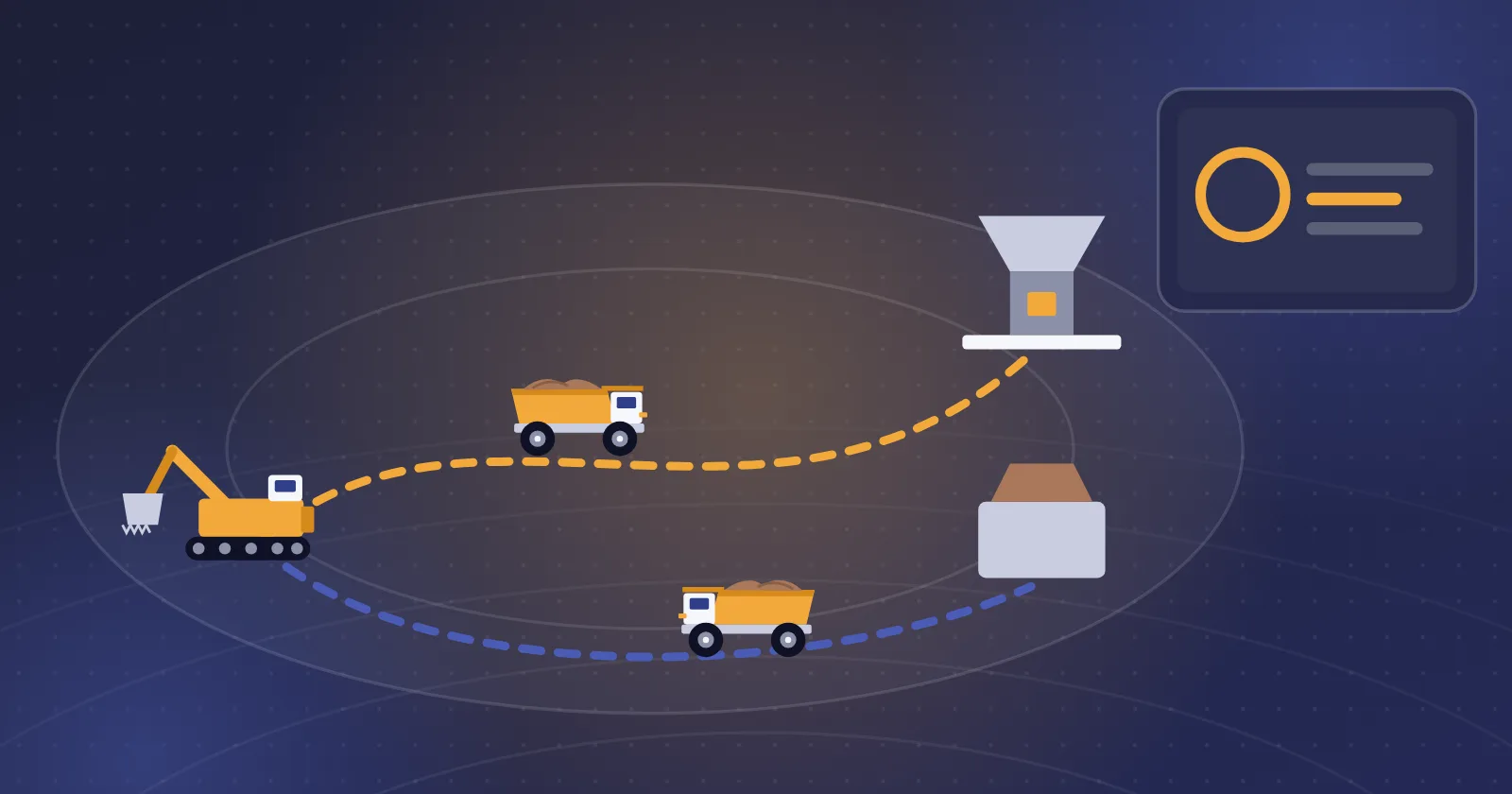
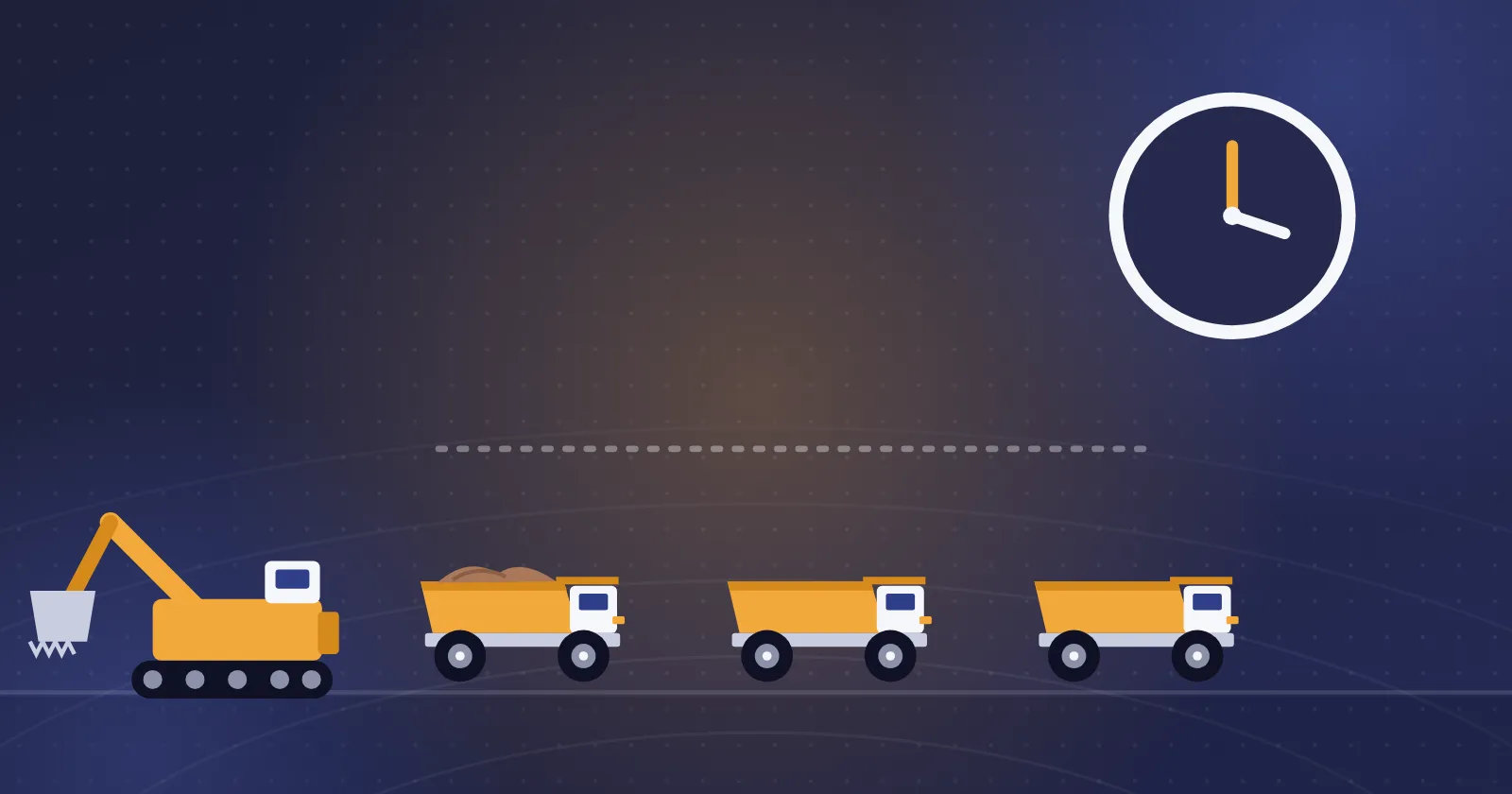
In open-pit mines, every minute a haul truck stands still can affect haulage productivity. When several trucks wait in front of a shovel or queue at the dump, part of the fleet's operating capacity is used up without moving any material.
Adding more trucks is not always the right way to increase production, though. In some situations, assigning more haul capacity to a shovel than it can serve lengthens the queue, burns fuel while idling and lowers the efficiency of the whole fleet.
Reducing haul truck waiting time depends on balancing loading capacity, the number of haul trucks, cycle time and the capacity of dump points.
This article looks at the main causes of truck queues, how to calculate waiting time and practical ways to optimise haulage in open-pit mines.
What is haul truck waiting time?
Haul truck waiting time is the time a machine spends waiting to be loaded, to dump or to complete another operating step.
For example, when a truck arrives at the loading point while the shovel is busy loading another truck, it has to wait until loading capacity becomes free.
This time can be part of the haul cycle and, if repeated, affects the number of trips that can be made in each shift.
Types of haul truck waiting time
For an accurate analysis, fleet stoppages are best divided into several groups.
| Type of wait | Description |
|---|---|
| Loading queue | Truck waiting for access to the shovel or loader |
| Dumping queue | Waiting to dump at the crusher, stockpile or waste dump |
| Dispatch delay | Machine ready but not yet given a haul assignment |
| Traffic delay | Stops or delays caused by traffic, route restrictions or crossing control |
| Fuelling queue | Waiting in line at the fuel station |
These are not all the same in nature. Time spent in the loading queue, for example, is different from time when the machine is unavailable because of a breakdown.
Classifying stops correctly matters, because each type of wait needs a different corrective action.
Why does haul truck waiting time increase?
Longer waiting times are usually the result of a mismatch between the capacities of different parts of the haulage operation.
More trucks may be assigned to a shovel than it can load, a haul road may face traffic constraints or the crusher's dumping capacity may drop.
Changes in cycle time, equipment breakdowns and a lack of timely information about loading and dump points can also cause queues.
1. Too many trucks assigned to a shovel (over-trucking)
One of the main causes of queues is assigning too many trucks to a single loading machine.
Each shovel has a defined capacity for loading trucks, based on bucket size, material conditions, the number of loading passes and operating time.
If trucks arrive faster than the shovel can serve them, a queue forms.
Suppose a shovel needs four minutes on average to load each truck. If several trucks arrive at almost the same time, the ones at the back must wait until the trucks ahead are loaded.
In this situation, adding another truck may simply make the queue longer.
2. Too few trucks assigned to a shovel (under-trucking)
Conversely, assigning too few trucks can leave the shovel idle.
If the shovel waits a long time for the next truck after finishing one, part of its loading capacity goes unused.
The goal of fleet management is therefore not just to reduce truck waiting time; it is to balance truck waiting time against shovel idle time.
In some cases, cutting the number of assigned trucks too far may shorten the queue but reduce tonnage at the same time.
3. Variations in haul cycle time
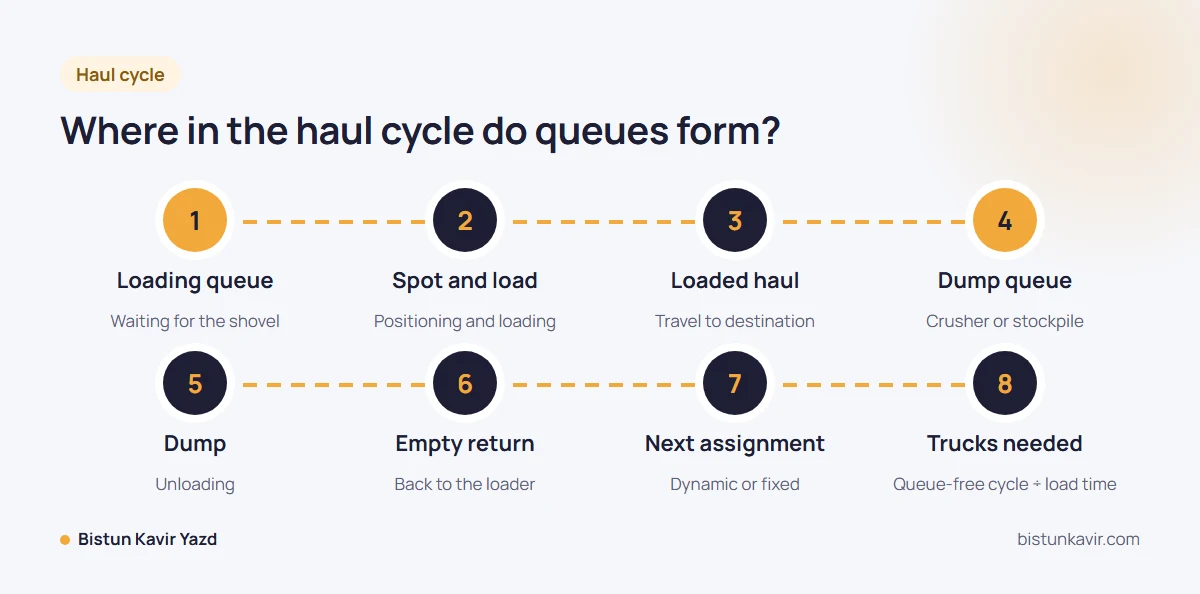
Haul cycle time includes loading, loaded travel, dumping and the truck's return to the loading point.
This time does not stay constant through a shift.
Road conditions, traffic density, haul distance, weather and equipment performance can all lengthen or shorten each cycle.
For example, if several trucks are held up by traffic and then reach the loading point almost together, a new queue may form at the shovel.
This is known as truck bunching.
4. Limited capacity at dump points
Queues do not only form at the loading point.
In mines where trucks deliver material to a crusher, stockpile or designated dump, the capacity of those points also affects cycle time.
If the crusher stops temporarily or access to the dump is restricted, incoming trucks may have to wait.
Continuing to send machines to an inactive destination can make the queue longer.
For this reason, the status of dump points should be considered in fleet assignment decisions.
5. Weak coordination and information flow
In some mines, information about the status of shovels, trucks and dump points is passed on by radio or manual reports.
These methods have a role in managing operations, but delays in passing on information or the lack of an integrated view of the fleet can make decisions harder.
For example, if a shovel stops because of a technical problem but the dispatcher is not told in time, more trucks may be sent to the same point.
As a result, not only is the shovel stopped, but part of the haul capacity also ends up in an unnecessary queue.
How do you calculate haul truck waiting time?
To reduce waiting time, you first need to measure it with a clear definition and reliable data.
One way to calculate waiting time at the loading point is to record when the truck joins the queue and when loading starts.
Loading wait time = loading start time − time of joining the loading queue
For example, if a truck joins the queue at 10:20 and loading starts at 10:27, its waiting time is seven minutes.
Manoeuvring and positioning time at the loading point (spotting time) should be separated from waiting time, otherwise the report may overstate the real queue time.
Average haul truck waiting time
To evaluate fleet performance, average waiting time can be calculated for a shift or a defined period.
Average waiting time = total waiting time ÷ number of cycles reviewed
Suppose 100 loading cycles are recorded in a shift and their combined waiting time is 450 minutes.
The average waiting time is then 4.5 minutes per cycle.
For a comparable calculation, cycles with no wait should also be included in the data with a value of zero.
Why the average alone is not enough
Average waiting time can hide some operational problems.
For example, most trucks may wait only one or two minutes, while some machines spend more than 15 minutes in the queue during busy periods.
In that case, looking at the distribution of waiting times, the 90th percentile and the longest waits gives more precise information about operational bottlenecks.
Key indicators for analysing haul truck queues
To evaluate the haulage system, waiting time should be reviewed alongside other operational indicators.
| Indicator | Use |
|---|---|
| Average Queue Time | Average time spent waiting in the queue |
| Queue Frequency | Percentage of cycles that involved a wait |
| Total Truck Queue Hours | Total fleet hours lost in queues |
| Shovel Idle Time | Time the shovel is idle waiting for trucks |
| Haul Cycle Time | Time to complete a haul cycle |
| Truck Utilization | How much of a truck's available time is used |
| Tonnes per Hour | Material moved per unit of time |
For example, a lower average waiting time is only valuable if it does not cause an unacceptable drop in production rate or an increase in shovel idle time.
That is why reviewing truck waiting time, shovel idle time and tonnage together is important for operational decisions.
7 practical ways to reduce haul truck waiting time
Reducing queues usually takes a combination of actions in fleet planning, route management, loading capacity control and assignment.
1. Balance the number of trucks against shovel capacity
The first step is to check the match between loading and haulage capacity.
The right number of trucks for each shovel depends on loading time, haul cycle time, equipment capacity and changing operating conditions.
For an initial estimate, the following relationship can be used:
Approximate number of trucks = cycle time without queuing ÷ average shovel service time per truck
Suppose the haul cycle without queuing is 32 minutes and the average loading time per truck is four minutes.
The initial estimate is then eight trucks.
This figure is not an exact or optimal number, however.
Real calculations must also account for variations in travel time, technical stops, manoeuvring time, route conditions and uncertainty in truck arrivals.
Even if average loading and haulage capacity are equal, timing fluctuations can still cause queues or leave the shovel temporarily idle.
This relationship should therefore be treated as a starting point for analysis, not a fixed rule for assigning the fleet.
2. Use dynamic fleet assignment (dynamic dispatching)
With fixed assignment, trucks may be allocated to one shovel or route for a long time.
This can work under stable conditions, but changes in mine operations may call for assignments to be revised.
With dynamic assignment, the decision about a truck's next task is based on the current state of the fleet and operational needs.
For example, if one shovel has a long queue and another has spare loading capacity, some eligible trucks may be reassigned to the second point.
The final decision must still respect the production plan, material destinations, load type, equipment compatibility, permitted routes and safety requirements.
The aim of dynamic dispatching is not simply to send trucks to the shortest queue; it is to balance the whole loading and haulage system.
3. Manage when trucks arrive at the loading point
Sometimes the total number of assigned trucks is right, but their arrival times at the shovel are poorly spread.
If four trucks reach the loading point almost together, the chance of a queue rises.
Spreading arrival times properly can prevent unnecessary bunching.
This can be done by adjusting assignments, setting permitted routes or improving coordination between loading and dump points.
Importantly, trucks should not be made to stop or slow down unnecessarily on the road just to make the queue disappear, as that may only move the lost time elsewhere.
The yardstick should be total cycle time, productivity and operational safety.
4. Review haul roads and traffic points
Road width, intersections, shared crossings and road quality can all affect fleet flow.
In some mines, a constrained intersection or delayed access to a ramp causes trucks to bunch and makes arrival times at the shovel fluctuate.
To find these problems, the location of stops, travel time through different road sections and traffic density can be reviewed.
Corrective actions may include better traffic management, revised permitted routes and fixing bottlenecks.
Any route change must be coordinated with engineering assessment, speed limits and the mine's safety requirements.
5. Manage dump point capacity
To reduce waiting time, the performance of dump points must also be reviewed.
For example, if a crusher goes offline temporarily, continuing to send trucks to it can create a queue.
In that case, timely notification of the crusher's status and review of permitted alternative destinations can prevent waiting from growing.
Changing material destinations must, however, be consistent with the production plan, grade control, stockpile capacity and other operational constraints.
6. Coordinate maintenance with haulage
A sudden shovel breakdown can affect many trucks.
That is why coordination between maintenance, operations and dispatch is so important.
If a shovel's planned shutdown is known in advance, truck assignments can be revised to match the remaining capacity.
Quick notification of unexpected stops also helps redirect trucks already on the move to another suitable task, where possible and within constraints.
7. Monitor fleet data continuously
Corrective actions can only be evaluated if performance is recorded before and after the changes.
For example, if the goal is to reduce the loading queue, track how average waiting time, the number of cycles with a queue, shovel idle time and tonnage have changed.
If the queue shrinks but tonnage also falls significantly, the action may not be right for the mine's overall productivity.
Decisions should therefore be based on a set of indicators.
Worked example: the effect of lower waiting time on fleet performance
To see the effect of waiting time, consider a hypothetical open-pit scenario.
Suppose a group of trucks completes 180 haul cycles in a shift, with an average loading wait of five minutes per cycle.
After revising truck assignments and improving coordination with the shovels, the average wait drops to three minutes.
| Indicator | Before | After |
|---|---|---|
| Cycles reviewed | 180 | 180 |
| Average wait per cycle | 5 minutes | 3 minutes |
| Total fleet waiting time | 900 minutes | 540 minutes |
| Total waiting hours | 15 hours | 9 hours |
| Average cycle time (other stages unchanged) | 37 minutes | 35 minutes |
In this scenario, total recorded fleet waiting time has fallen by six hours.
This equals six hours of combined machine time, not necessarily six more hours of production or a six-hour shorter shift.
With other factors unchanged, lower waiting time can free up more time for haulage, but the real production gain depends on shovel capacity, dump destinations, fleet size and the operating plan.
The figures in this example are hypothetical and only illustrate the calculation and evaluation method.
Industry example: reducing truck queues at the Grib mine
One example of smart queue management is the Grib mine, described in a case study published by Komatsu in 2024.
At this mine, changes in the crusher's operating status and delays in informing the dispatcher meant trucks were still being sent to the crusher while it was stopped.
As a result, machines queued on the crusher access road and idle time increased.
By linking crusher status data to dispatch decisions, trucks could be redirected whenever the crusher stopped.
According to Komatsu, the idle time under review fell from 210 hours a month to 38 hours a month.
This example shows that a queue problem is sometimes caused less by the number of machines than by a lack of timely information and weak coordination between parts of the operation.
These results relate to that mine's conditions and should not be read as a guaranteed reduction for other mines.
Source: Komatsu – DISPATCH Fleet Management Case Study
The role of mine dispatching in reducing truck waiting time
Mine dispatching is one of the tools for managing and coordinating the haul fleet in open-pit mines.
A dispatching system uses information on the position and status of machines, loading points, dump destinations and haul assignments to plan and control operations.
This information can help operations staff see the state of queues and revise truck assignments where needed.
Fixed assignment versus dynamic dispatching
| Criterion | Fixed assignment | Dynamic dispatching |
|---|---|---|
| How trucks are assigned | According to a predefined plan | According to current status and operational constraints |
| Response to a shovel stop | Requires the plan to be revised | Assignments can be reviewed more quickly |
| Queue management | Depends on monitoring and operational intervention | Current data can be used for decisions |
| Changing a truck's destination | Usually by plan or new instruction | Based on the status of permitted loading and dump points |
| Implementation complexity | Lower | Higher and dependent on data quality |
Note that a dispatching system alone does not guarantee that queues disappear.
Data quality, assignment rules, equipment compatibility, road conditions and how managers use the information all affect the final result.
Managing fleet waiting time with Bistun's BiSmart system
Bistun Kavir Yazd, a knowledge-based company, develops smart systems for managing mining operations and fleets.
BiSmart is one of the company's products for managing, monitoring and dispatching open-pit mining fleets.
In haulage management, accurate information on machine status, equipment position and fleet activity can help identify the causes of stoppages and explore opportunities for improvement.
Operationally, this data can be used to analyse issues such as how trucks are distributed between shovels, waiting time and haul cycle performance; the details of reports and assignment features depend on the system's configuration and capabilities.
How do you start assessing the need for a dispatching system?
Before choosing or implementing a fleet management system, it is best to define the mine's real operating conditions.
The number of shovels and trucks, haul routes, communications, how assignments are recorded and the main current bottlenecks should all be reviewed.
Defining measurable goals, such as reducing waiting time, improving fleet utilisation and increasing tonnage hauled, can also provide a basis for evaluating the results.
To learn about the system and the features available for your mine's conditions, see the BiSmart dispatching and monitoring system page.
Common mistakes in reducing haul truck waiting time
A common mistake is trying to eliminate queues completely without regard to shovel capacity and production targets.
If the number of trucks is cut too far, the loading queue may shrink but shovel idle time may rise.
Another mistake is focusing only on average waiting time. Sometimes most of the problem occurs in short but busy periods, which a daily average cannot reveal.
Moving the wait from the loading point to another part of the operation does not necessarily improve productivity either.
For example, if trucks spend a similar amount of time stopped waiting for an assignment instead of queuing at the shovel, the fleet's total non-productive time has not fallen.
Ultimately, every corrective action should be evaluated on its effect on overall haulage, production, cost and safety.
Frequently asked questions about mining haul truck waiting time
What is the main cause of truck queues at the loading point?
One of the main causes is an imbalance between the rate at which trucks arrive and the shovel's service capacity. Variations in cycle time, machines arriving together and technical stops can also make queues longer.
How many trucks should be assigned to each shovel?
The right number depends on haul cycle time, loading time, equipment capacity, road conditions and production targets. The ratio of queue-free cycle time to average loading time can be used for an initial estimate, but setting the right number requires more detailed analysis.
Does adding trucks increase mine production?
Not always. If shovel loading capacity or dump capacity is limited, adding trucks may only lengthen the queue and increase waiting time.
How can haul truck waiting time be reduced?
Revising truck assignments, managing arrival times, reviewing haul roads, improving coordination at dump points and using current operational data are key ways to reduce waiting.
What is the difference between truck waiting time and shovel idle time?
Truck waiting time is when the machine waits to be loaded or to carry out an activity. Shovel idle time, in this context, is when the loading machine is ready to work but no suitable truck is there to receive a load.
Can smart dispatching eliminate truck queues?
Dispatching can help manage and reduce some unnecessary queues, but eliminating waiting entirely under all operating conditions is not realistic. Natural variations in cycle time, capacity limits and unforeseen disruptions may still cause queues.
Conclusion
Reducing haul truck waiting time is one of the most important ways to improve haulage performance in open-pit mines.
Long queues can lengthen cycle times, leave part of the fleet's capacity unused and affect operating costs.
That said, reducing queues is only valuable if it maintains or improves the performance of the whole haulage system.
Balancing shovel capacity against the number of trucks, revising assignments, reviewing haul roads and using real operational data are among the most important ways to manage waiting time.
Dispatching and fleet management systems such as Bistun's BiSmart can provide the infrastructure to monitor machine activity and support decisions in haulage operations.
To learn more about fleet management and monitoring features, visit the Bistun Kavir Yazd BiSmart system page.
Sources
- Global Mining Guidelines Group – A Standardized Time Classification Framework for Surface Mining
- Komatsu – DISPATCH Fleet Management System
- Komatsu – Grib Mine DISPATCH Case Study
- Digitalization of Mine Operations: Scenarios to Benefit in Real-Time Truck Dispatching
- Optimization of Shovel-Truck System for Surface Mining – Istanbul Technical University