In an open-pit mine, dozens of haul trucks, shovels, loaders and support machines must work in coordination. Each truck has to reach the right loading unit at the right time, deliver material along the designated route to the correct destination and receive its next task without creating queues or unnecessary stops.
Managing this cycle with radio calls and the dispatcher's experience alone is hard. A shovel breakdown, a crusher stop, a growing queue at the dump or a blocked road can change the original plan within minutes. If truck assignments are not adjusted to these changes, part of the fleet's capacity is lost in queues, stops or non-productive trips.
A mine dispatching system is designed for exactly these conditions. It collects information on the position, status and assignment of machines and helps the control room manage haul trucks, loading equipment and dump destinations in a coordinated way.
The main purpose of dispatching is not just to show machines on a map. A complete system must analyse the state of operations, detect bottlenecks, suggest the right assignment and measure the outcome of decisions against defined indicators.
What is a mine dispatching system?
A mine dispatching system is a combination of software and hardware for monitoring, assigning and controlling the loading and haulage fleet. It receives real-time equipment data and manages haul truck assignments based on the production plan, machine positions, shovel status, queues, routes and destinations.
English sources use terms such as mining dispatch system, truck dispatching and fleet management system.
Established fleet management systems present dispatching as a tool for real-time visibility, smart assignment of trucks to loading and dump points, shorter waiting times and more effective use of equipment.
A dispatching system can:
- Record machine position and status
- Assign haul trucks to shovels or loaders
- Set dump destinations
- Manage loading and dumping queues
- Monitor the haul cycle
- Record stops
- Detect route deviations
- Compare actual production with the plan
- Send assignments to operators
- Provide shift and management reports
How does mine dispatching differ from GPS tracking?
A GPS tracker usually shows a machine's position, speed and route. This information is useful for traffic control but does not, on its own, show what task the machine has or which stage of the operation it is in.
For example, a tracker shows that a haul truck has stopped next to a shovel, but it may not be able to tell:
- Whether the truck is queuing or being loaded?
- How long it has been waiting?
- Whether it should have been sent to another shovel?
- What type of material it is carrying?
- Where the load is going?
- Whether its assignment matches the production plan?
A dispatching system analyses this data in the context of the production process. GPS is therefore one of the system's data sources, not the whole system.
In summary:
| Capability | GPS tracker | Dispatching system |
|---|---|---|
| Position display | Yes | Yes |
| Speed and route recording | Yes | Yes |
| Detecting operating stage | Limited | Yes |
| Truck assignment | No | Yes |
| Queue management | No | Yes |
| Link to production plan | No | Yes |
| Cycle time analysis | Limited | Yes |
| Production reporting | Limited | Yes |
| Real-time reassignment | No | Yes |
How does dispatching differ from fleet management?
Fleet management is a broader concept than dispatching.
Dispatching focuses mainly on assigning and coordinating loading and haulage, while a fleet management system may also cover:
- Machine health monitoring
- Maintenance management
- Fuel management
- Payload control
- Tyre monitoring
- Operator evaluation
- Speed control
- Cost reporting
- Support equipment management
In many industrial products, dispatching is one of the core modules of a fleet management system. Commercial fleet management solutions, for example, record cycle time, payload, material blending and other operational parameters in addition to reassigning equipment.
In other words:
Dispatching is responsible for real-time coordination of tasks; fleet management gives a broader picture of equipment performance, cost, health and usage.
Why do mines need a dispatching system?
The loading and haulage cycle is a dynamic system. The status of equipment, routes and destinations can change many times during a shift.
Common problems in traditional management include:
- Trucks bunching at one shovel
- Shovels waiting for trucks to arrive
- Queues at the crusher
- Loads sent to the wrong destination
- Late notice of equipment breakdowns
- Machines standing idle without a task
- Unnecessary routes
- Discrepancies between driver reports and the control room
- No accurate information on shift performance
With fixed dispatching, trucks are usually assigned to one shovel or route at the start of the shift. This works as long as conditions do not change.
In a real mine, however, travel and loading times are not constant. Road conditions, operator skill, queues, breakdowns and the production plan can all change the best assignment. Dispatching research also treats truck-to-loader assignment as a time-critical decision affected by changing queues, travel times and equipment going out of service.
By receiving real-time data, a dispatching system makes it possible to revise assignments.
How does a mine dispatching system work?
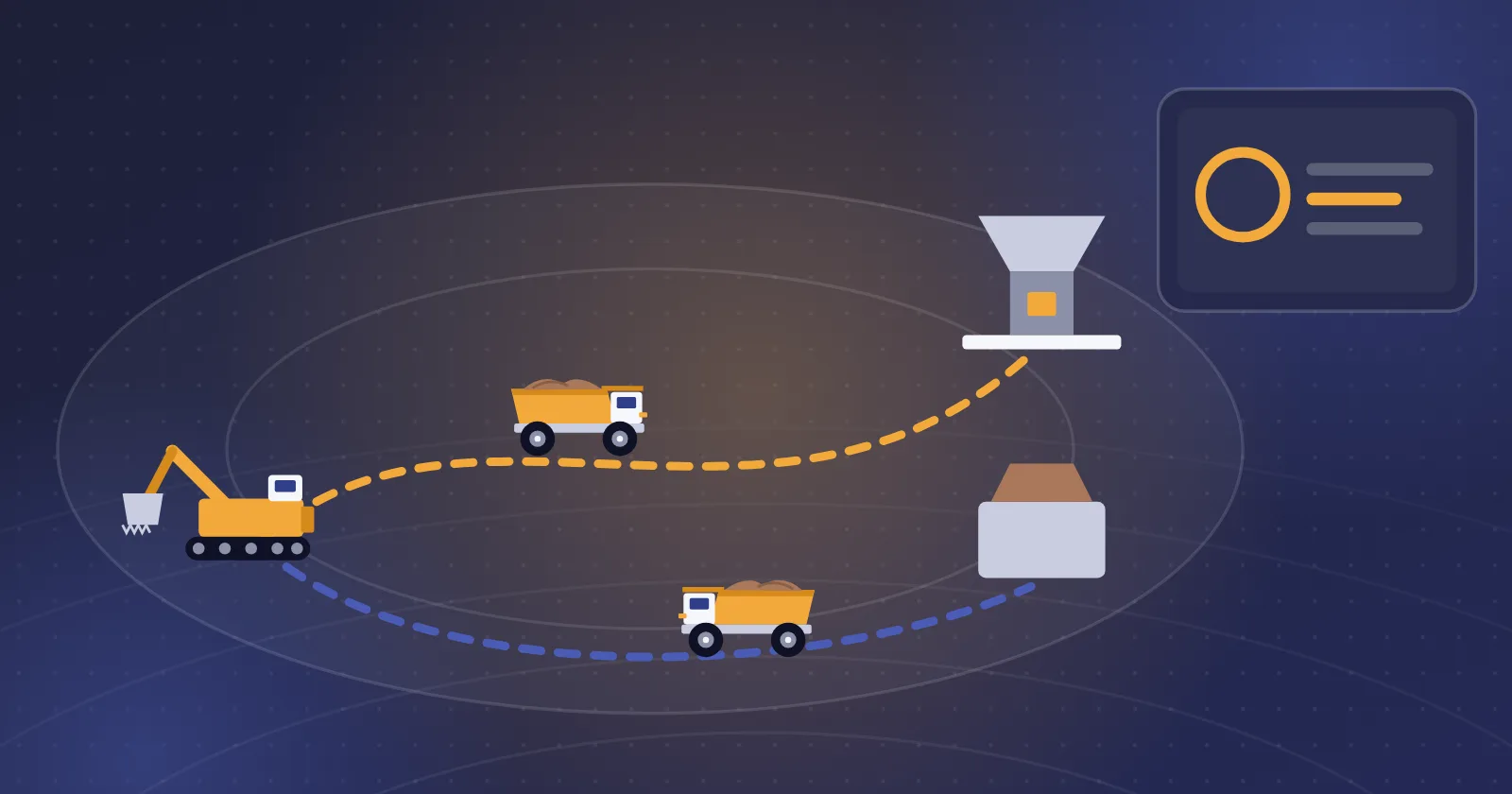
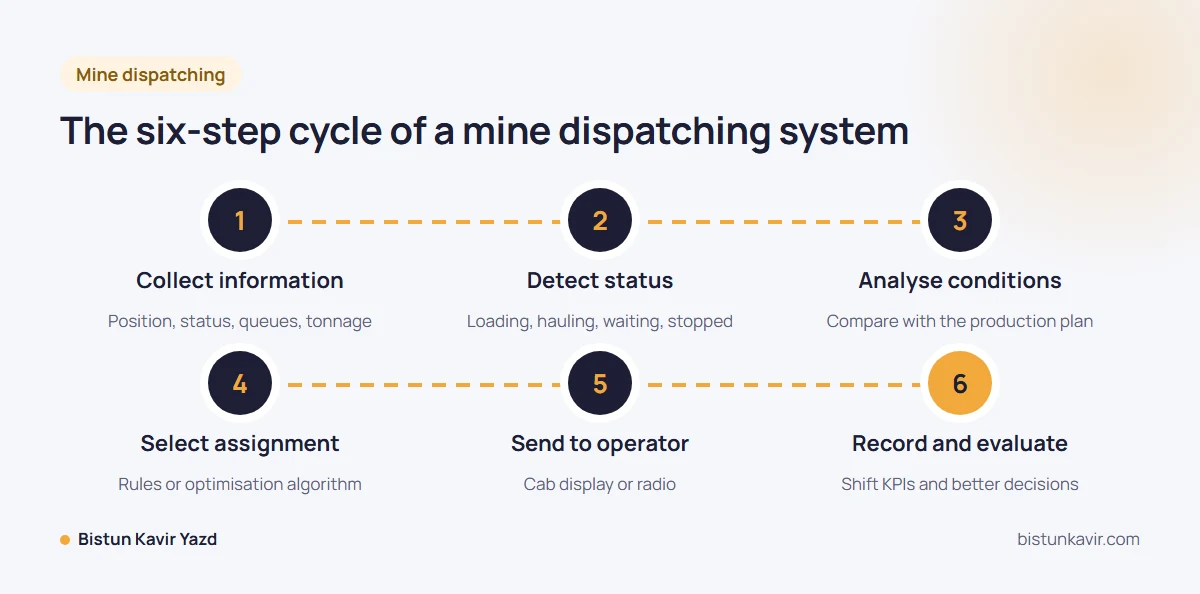
The system's operation can be summarised in a six-step cycle:
1. Collecting information
Information is received from equipment, operators and other systems. The most important data includes:
- Machine position
- Speed
- Direction of travel
- Engine status
- Type of task
- Loading unit
- Dump destination
- Arrival and departure times
- Shovel status
- Crusher status
- Queues
- Tonnage or payload
- Material type
2. Detecting operating status
The system tries to determine the status of each machine:
- Ready
- Travelling empty
- Waiting to load
- Loading
- Travelling loaded
- Waiting to dump
- Dumping
- Refuelling
- Under maintenance
- Stopped without a task
These states can be detected automatically from GPS data, sensors, operator input or a combination of sources.
3. Analysing site conditions
The system compares the current state of operations with the production plan:
- Which shovel does not have enough trucks?
- Where has the queue become long?
- Which destination has spare capacity?
- Which equipment has gone out of service?
- Which machine is close to finishing its task?
- Which material must go to which destination?
4. Selecting the assignment
Based on defined rules or an optimisation algorithm, the right assignment is chosen for the truck.
The goal may be one or more of the following:
- Shorter waiting time
- Higher production
- Feed quality control
- Shorter haul distance
- Lower cost
- Executing the production plan
- Balancing the fleet
Dispatching research shows that assignment is not limited to the shortest route and can simultaneously take into account the quantity and quality of material each destination needs.
5. Sending instructions to the operator
The assignment is sent to the operator through an in-cab display, message or radio.
The message can include:
- Loading unit
- Dump destination
- Route
- Material type
- Task priority
- Operational alerts
6. Recording and evaluating the result
The system records the time each task took and the status of each stage. This data is used to analyse shift performance and refine later decisions.
How do fixed and dynamic dispatching differ?
Fixed dispatching
In fixed dispatching, a truck is assigned to one shovel and destination for a set period.
Advantages:
- Simple to run
- Less infrastructure needed
- Easy for operators to understand
Limitations:
- Slow response to changing conditions
- Higher chance of queues
- Unbalanced use of equipment
- Greater dependence on human decisions
Dynamic dispatching
In dynamic dispatching, a machine's assignment changes according to the real-time state of operations.
For example, if the crusher stops, trucks already on their way can be redirected to a stockpile or another destination. In one published case study, passing crusher status to the dispatcher and reassigning trucks prevented unnecessary queues and reduced fleet idle time in that project. This result relates to that mine and its specific conditions and should not be applied to another project without review.
Dynamic dispatching requires real-time data, a stable communication network and correctly defined operational rules.
Main components of a mine dispatching system
On-machine equipment
This equipment may include:
- GPS or GNSS
- A telemetry unit
- An in-cab display
- A communication modem
- A CAN or J1939 connection
- Sensor inputs
- An operator card or ID
- Onboard memory
Communication infrastructure
Machines and the control room can communicate over different networks:
- Radio network
- Industrial Wi-Fi
- Private LTE
- 4G or 5G
- Hybrid network
If the network drops, the on-machine unit should store data and send it to the server once reconnected. Alarms and critical functions should not depend entirely on a permanent connection.
Server and database
The server receives, stores and processes operational data. It can be located at the mine, in the company's data centre or in the cloud.
Key considerations include:
- Storage capacity
- Backups
- Access levels
- Cybersecurity
- Change logging
- Time synchronisation
- Recovery after outages
Control room software
The dispatcher views the fleet's status through the control room software.
The user interface usually includes:
- A live mine map
- Equipment status
- A task list
- Queues
- Alarms
- The production plan
- Shift reports
- Operational KPIs
Assignment and optimisation engine
The assignment engine chooses a machine's destination or task based on data and the mine's rules.
It may use:
- Fixed rules
- Queueing algorithms
- Linear programming
- Multi-objective optimisation
- Simulation
- Machine learning algorithms
A complex algorithm alone does not guarantee a better result. Data quality, the mine's real constraints and how the objective is defined matter more.
Which KPIs does a dispatching system measure?
Cycle time
Cycle time is the full duration of a haul cycle and usually includes:
- Waiting to load
- Loading
- Travelling loaded
- Waiting to dump
- Dumping
- Returning empty
Analysing each stage shows where the main delay occurred.
Queue time
Queue time is how long a truck waits to load or dump.
Long queues may be caused by:
- Too many trucks sent to one shovel
- Low destination capacity
- Crusher stops
- Route disruptions
- Poor assignment
Shovel hang time
This indicator shows how long a shovel is ready to work but has no truck to load.
High queue time and high shovel hang time can both indicate a poor balance between the number of trucks and loading capacity.
Idle time
Idle time is when a machine is running or ready but not doing productive work.
The system should distinguish between necessary and avoidable stops. Stops for safety checks, maintenance or planned queuing should not be treated the same as stops without a task.
Utilisation
Utilisation shows how much of a machine's available time is used for productive work.
Availability
Availability refers to the technical readiness of equipment. It is mainly linked to maintenance but also affects dispatching decisions.
Trips per shift
The number of trips per shift, route or machine is measured. This figure should be reviewed alongside tonnage, cycle time and safety.
Tonnes per hour
Tonnes moved per hour is one of the main production indicators. It should be increased without overloading, speeding or removing safety controls.
Plan compliance
This indicator shows how closely actual performance matched the production plan in terms of:
- Tonnage
- Material type
- Destination
- Number of trips
- Working face performance
Payload compliance
This indicator shows how closely each truck's load matches its rated capacity. Underloading reduces production capacity, while overloading can damage tyres, suspension and roads and compromise safety.
Benefits of a mine dispatching system
Shorter queues and waiting times
Assigning trucks in proportion can stop the fleet bunching at one point. Established fleet management solutions also list reducing queues, idling and loading equipment waiting time among the main goals of dispatching.
Better use of the existing fleet
Managers can identify unused fleet capacity without immediately buying new machines. This benefit can be proven when utilisation, trip counts and tonnage are compared before and after.
Faster response to change
A shovel breakdown, crusher stop or road closure can change assignments. The system makes faster reassignment possible.
Fewer manual reports
Arrival and departure times, assignments, stops and trip counts can be recorded automatically, reducing reporting errors and discrepancies between departments.
Better control of the production plan
The system shows whether the required quantity and type of material has been delivered to the correct destination.
Data for continuous improvement
Operational history is used to identify bottlenecks, compare shifts and evaluate management decisions.
Does a dispatching system reduce fuel consumption?
A dispatching system does not directly change the engine or a machine's fuel consumption, but it can reduce some of the factors that drive consumption:
- Idling
- Queues
- Unnecessary trips
- Poor routes
- Travelling to a closed destination
- Stops with the engine running
To measure the result, it is better to use fuel per tonne rather than total fuel consumption. Lower total consumption may simply reflect lower production, whereas fuel per tonne shows the relationship between consumption and tonnage.
For a more accurate analysis, dispatching data should be linked to fuel management, payload and machine operating data.
Does dispatching increase production?
Production increases when fleet capacity has been limited by queues, stops or poor assignment.
The system can increase trip counts or tonnes per hour by reducing losses in the cycle. The result, however, depends on many factors:
- The mine's baseline
- Number of machines
- Shovel capacity
- Haul route
- Dump destination
- Network quality
- Operator acceptance
- Algorithm tuning
- Road conditions
- Equipment maintenance
Using a fixed percentage for every project is therefore not correct. Every result should be presented with a defined baseline, scope and measurement period.
Limitations and challenges of deploying a dispatching system
Poor data quality
If position, time or machine status is not recorded accurately, assignment decisions will not be reliable either.
Incomplete network coverage
Network outages can disrupt the sending of tasks and real-time data capture.
Incorrectly defined states
If waiting, idling, breakdowns or operational stops are not defined correctly, reports will be misinterpreted.
Too many alarms and messages
Sending many tasks or alarms can reduce operator focus. The in-cab interface should be simple and suited to the operating environment.
Operator resistance
Drivers may see the system as a tool for monitoring individuals. Training should explain that the aim is to improve operational flow and reduce waiting.
Isolated implementation
If the system is not connected to the production plan, weighbridge, fuel or destination status, some decisions will still be based on incomplete data.
Over-reliance on the algorithm
Emergencies, safety constraints or unforeseen changes may require human decisions. The system must allow the dispatcher to intervene and record the reason for any change.
How does dispatching connect with ERP, SCADA and other systems?
Integration increases the value of dispatching data.
ERP integration
Used to transfer production, cost, workforce and enterprise planning information.
SCADA integration
The status of the crusher, conveyors or processing equipment can be taken into account in truck destination decisions.
CMMS integration
Service and maintenance status shows which machines are available for tasks.
Weighbridge and payload integration
With a smart weighbridge, trip counts are matched with actual tonnage and underloading or overloading can be detected.
Fuel system integration
Each machine's fuel consumption is analysed alongside its tasks, route and tonnage.
Modern fleet management systems also emphasise bringing machine and operational data together to create a shared picture of the site.
What is the dispatcher's role after digitalisation?
A dispatching system does not remove the dispatcher's role; it changes the nature of the work.
In the traditional approach, much of the dispatcher's time is spent on radio calls, manual records and tracking machine positions. In a digital system, the focus shifts to:
- Managing exceptions
- Reviewing alarms
- Making decisions in unusual situations
- Coordinating with production and maintenance
- Adjusting the plan
- Reviewing KPIs
- Recording the reason for manual interventions
The algorithm can suggest assignments, but the dispatcher must recognise conditions that are not captured in the data.
How do you choose the right dispatching system?
Before choosing a solution, review these questions:
Is the system compatible with a mixed fleet?
Check whether it can be installed on both older and newer machines.
What data is collected?
The list of data and the accuracy of each item should be clear.
How does the system behave offline?
Local storage and synchronisation after reconnection are essential.
How is assignment carried out?
Review the rules, objectives and the ability to intervene manually.
Which KPIs does it provide?
The dashboard should match the mine manager's needs.
Does it have an API?
The ability to connect to ERP, SCADA, the weighbridge and existing systems is important.
Who owns the data?
Access, export and data retention should be specified in the contract.
How is support provided?
Calibration, training, updates and technical presence all matter.
Steps for deploying a mine dispatching system
1. Identify the problem
Do not start the project by choosing a technology. First identify the bottleneck:
- Long queues
- Long cycle times
- Low utilisation
- Gaps between plan and production
- Unreliable reports
2. Record the baseline
Measure current indicators before implementation.
3. Design the process
Define states, tasks, routes, equipment and responsibilities.
4. Prepare the infrastructure
Prepare the network, servers, on-machine equipment and database.
5. Run a pilot
Choose a limited part of the mine, for example one route, one shovel and part of the truck fleet.
6. Train users
Dispatchers, drivers, the production manager and the maintenance team must all know their role in the system.
7. Evaluate the result
Compare before and after KPIs and record external factors such as route changes or fleet growth.
8. Roll out in stages
Once the result is proven, extend the system to other machines and processes.
Conclusion
A mine dispatching system is not a simple tool for showing machine positions. It connects fleet data, the production plan, loading equipment and dump destinations so that haul truck assignments are managed according to the real state of operations.
Reducing queue time, controlling cycle time, increasing utilisation, cutting non-productive stops and improving plan compliance are among the system's most important goals. The project's result, however, depends on data quality, communication infrastructure, process definition and user buy-in.
The system creates value when:
- It targets a specific bottleneck.
- The pre-implementation state is measured.
- Assignments lead to operational action.
- The result is evaluated against measurable KPIs.
- Data is integrated with the mine's other systems.
To get started, it is best to pilot part of the loading and haulage cycle and evaluate the system under real mine conditions before extending it to the whole fleet.
Frequently asked questions
What does a mine dispatching system do?
The system monitors the position and status of machines and assigns haul trucks based on shovel status, queues, destinations and the production plan. It also records cycle time, stops, trip counts and production.
What is the difference between mine dispatching and fleet management?
Dispatching focuses mainly on assigning tasks and coordinating the loading and haulage cycle. Fleet management can cover broader areas such as maintenance, fuel, payload, equipment health and operator performance.
Does dispatching work without internet?
It depends on the system architecture. On-machine equipment should be able to store some data during network outages and send it once the connection is restored. Real-time assignment and communication with the control room require network coverage.
Can the system be installed on older machines?
In many cases, basic data from older machines can be captured with independent GPS, telemetry and sensors. Access to ECU data or advanced features depends on the machine model and architecture.
What is the most important dispatching KPI?
No single KPI is enough. Cycle time, queue time, shovel hang time, idle time, utilisation, trips per shift, tonnes per hour and plan compliance should be reviewed together.
Does a dispatching system reduce fuel consumption?
The system can help reduce fuel per tonne by cutting idling, queues, unnecessary trips and poor routes. For accurate measurement, dispatching data should be matched with fuel consumption and tonnage.
What is dynamic dispatching?
In dynamic dispatching, a truck's assignment changes according to the real-time status of shovels, queues, routes and destinations. Unlike fixed assignment, the machine is not necessarily tied to one route or shovel for the whole shift.
How large should a dispatching pilot be?
The pilot should be limited enough for data and results to be controlled, while still covering real operating conditions. One haul route, one or two loading units and part of the fleet can be a good starting point.