Fuel is one of the major operating costs of an open-pit mine. Haul trucks, shovels, loaders and other heavy machines need large quantities of diesel for extraction, loading and haulage. Yet not every litre burned translates directly into production or material moved.
Long stops with the engine running, poor haul routes, equipment faults and weak operational planning can all push fuel consumption up without a matching increase in output.
Controlling this cost takes more than capping fuel allowances or comparing how much diesel each machine receives. Mine managers need to look at fuel use in relation to operating hours, payload hauled, route conditions and the actual performance of the equipment.
This article examines the main reasons mining equipment fuel consumption increases, the indicators used to evaluate it and practical ways to control it in open-pit mines.
Why does fuel consumption rise in open-pit mines?
Higher fuel use is not always caused by machine faults or poor operator behaviour. Mine conditions change over time, and those changes affect the energy required to do the work.
For example, as the pit deepens and the mining face moves, haul distances or elevation differences may grow. Even if the number of truck trips stays the same, more fuel is needed to move the same quantity of material.
At the same time, long queues at loading points, road traffic, poor loading and unnecessary stops can also drive consumption up.
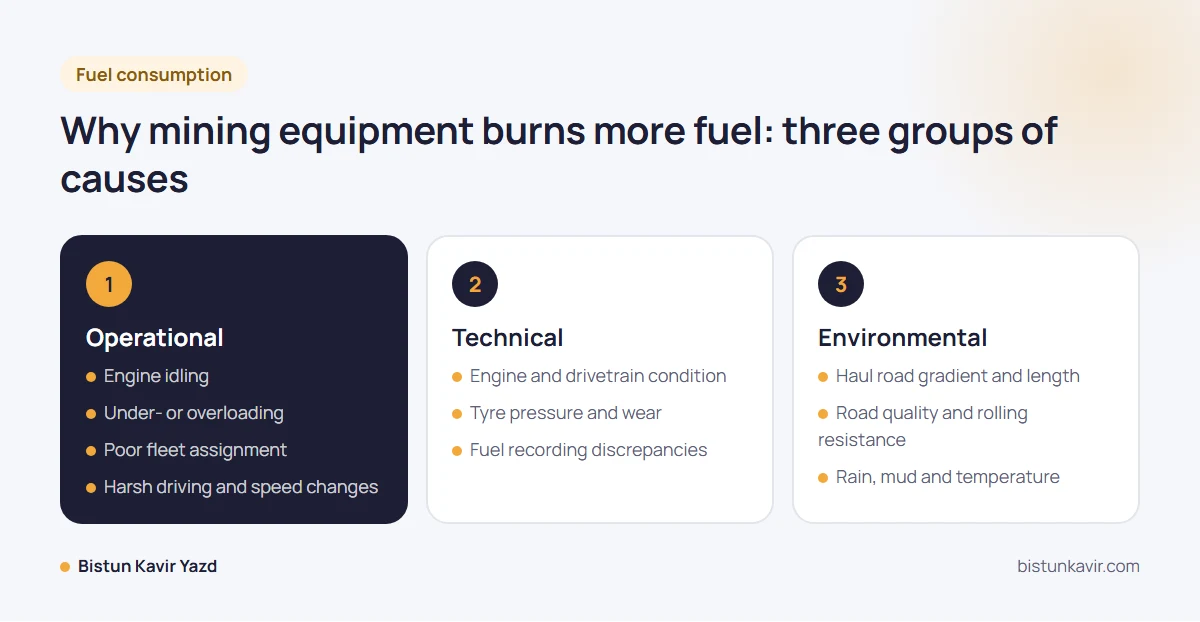
For a clear analysis, the factors behind fuel consumption are best grouped into three categories:
| Factor group | Examples |
|---|---|
| Operational | Queuing, cycle time, poor fleet assignment, payload |
| Technical | Engine condition, tyres, drivetrain and maintenance |
| Environmental | Road gradient, road quality, weather and rolling resistance |
Separating these factors helps match corrective action to the real cause of the problem.
1. Long stops with the engine running (engine idling)
One source of fuel waste in open-pit mines is machines keeping their engines running while doing no productive work.
This condition, known as engine idling, can occur while a truck waits to be loaded, stops at the dump or waits for its next assignment.
The engine keeps burning fuel, but the machine may not be moving any material.
Not every stop can be eliminated, of course. Some are necessary for operational steps, safety requirements or the technical condition of the equipment. The real goal is to identify and reduce the stops that add no operational value.
How do you identify unnecessary stops?
To analyse machine stops, the machine's position, engine status, stop duration and operating stage need to be reviewed together.
For example, if several trucks consistently spend a long time in a shovel's queue, the issue may lie in the ratio between that shovel's loading capacity and the number of trucks assigned to it.
In that situation, cutting waiting time by correcting fleet assignment can be more effective than imposing a general limit on engine running time.
2. Haul road gradient and length
The haul route is one of the main factors determining a haul truck's fuel consumption.
When a truck climbs a ramp, especially fully loaded, its engine has to produce more power to overcome road resistance and the change in elevation.
Changes in gradient and length can therefore change the fuel required for each haul cycle.
For example, if mining moves from one part of the pit to a deeper bench, trucks may have to travel a longer or steeper route to reach the crusher or dump.
In that case, higher fuel consumption does not necessarily mean the engine has become less efficient.
The role of haul road quality
Road surface quality also affects fuel use.
Uneven surfaces, mud, loose rocks and poorly maintained roads increase rolling resistance, so the machine needs more energy to move.
Proper haul road maintenance, grading and water management can remove part of this extra resistance.
Route choice should not be based on the shortest distance or lowest fuel use alone, however. Road capacity, permitted gradient, braking conditions, travel safety and the production plan must also be considered.
3. Loading below or above the target range
The payload carried on each trip is another important factor in evaluating haul truck fuel consumption.
When a truck carries less than its target load, more trips may be needed to move a given quantity of ore.
Every extra trip involves travelling, stopping, loading and dumping, all of which burn fuel.
Loading beyond the permitted range, on the other hand, can put more stress on the engine, tyres, suspension and other components.
Proper loading therefore does not mean pushing payload to the maximum possible; it must respect the machine's technical limits and rated capacity.
How do you evaluate loading?
One method is to compare each trip's actual payload with the target range defined for that truck model.
For this analysis, weighing data has to be linked to trip counts, haul routes and fuel consumed.
Data from Bistun's weighing system can help record and review payload information in this process.
4. Engine and drivetrain condition
Higher fuel use may also reflect a change in the technical condition of the machine.
Fuel system problems, clogged filters, cooling system faults or drivetrain issues can all affect engine performance and energy use.
Higher fuel consumption alone, however, is not enough to diagnose a specific fault.
For example, if a truck's consumption has risen compared with its historical average, first check whether its haul route, payload or working conditions have changed.
If operating conditions have stayed broadly the same, reviewing technical data and maintenance records can help pinpoint the cause.
The importance of preventive maintenance
Maintaining equipment according to the manufacturer's instructions, operating hours and actual working conditions can stop some technical problems from persisting.
Keeping maintenance records alongside fuel data also helps managers assess the effect of technical interventions.
For example, a machine's fuel trend can be compared before and after a fault is fixed, provided the two periods have comparable operating conditions.
5. Tyre condition and rolling resistance
Tyres play an important role in the performance of mining haul trucks and loaders.
Incorrect inflation pressure, wear, damage and tyres unsuited to the operating conditions can all affect rolling resistance and energy use.
For example, pressure below the recommended range can increase tyre deflection and rolling resistance.
Inflation should, however, follow the manufacturer's guidance and suit the load, speed, temperature and operating conditions.
Tyre management should therefore be part of the machine performance programme, not a standalone measure just to save fuel.
6. Poor driving and sharp speed changes
The way an operator works can also affect the fuel consumption of mining machines.
Harsh acceleration, frequent braking, unnecessary speed changes and driving unsuited to road conditions can increase energy use.
That does not mean always driving slower. Very low speeds can lengthen cycle times and, in some cases, reduce productivity.
The aim is driving behaviour that suits the machine's specifications, road conditions and safety requirements.
Can operator training reduce fuel consumption?
Training in correct equipment operation, combined with feedback based on real data, can help reduce unnecessary behaviours during operations.
To evaluate this, operators' fuel use is best compared on similar routes, machine models and working conditions.
Attributing consumption differences to operators without controlling for other factors can lead to wrong conclusions.
7. Poor fleet assignment and weak dispatching
A lack of coordination between loading and haulage equipment is one reason fuel use rises in haulage operations.
If more trucks are assigned to a shovel than its effective loading capacity, queues can form.
Conversely, assigning too few trucks can leave the shovel idle and disrupt the production plan.
Frequent route changes or sending machines to the wrong points can also increase travel time and fuel use.
How is dispatching linked to lower fuel consumption?
Dispatching manages assignments, allocates equipment and coordinates the stages of haulage.
When fleet assignment decisions are based on the real status of machines and loading points, some unnecessary stops and movements can be avoided.
Fuel savings should still be assessed alongside production, safety and equipment capacity goals. Shorter waiting times on their own do not guarantee that the mine's total fuel consumption has fallen.
8. Weather and environmental conditions
Environmental conditions can also change machine fuel consumption.
Rain, muddy roads, changes in rolling resistance and unusual temperatures can affect travel conditions and equipment performance.
For example, after rain, trucks may need more energy on part of the route or have to travel more slowly for safety reasons.
For this reason, fuel trends should be reviewed alongside a record of significant environmental changes.
This information helps separate increases caused by changing site conditions from those linked to technical faults or operational inefficiency.
9. Discrepancies in fuel recording and delivery
Sometimes a reported increase in consumption is not a real increase in fuel burned, but a discrepancy in records, measurement or the refuelling process.
For example, if the fuel delivered to a truck does not match the change in tank level and recorded data, management reports will show a discrepancy.
Such a discrepancy can have several causes, including manual entry errors, calibration problems, incomplete data or leaks.
A discrepancy in the data is not, on its own, evidence of misconduct or unauthorised use. Refuelling and measurement data must be reviewed and reconciled to find the cause.
Fuel delivered versus fuel consumed
The fuel delivered to a machine's tank over a period is not necessarily equal to the fuel consumed in that period.
To estimate consumption from tank balance, the following relationship can be used:
Estimated fuel consumption = opening stock + fuel received − closing stock
Using this relationship requires reliable stock and delivery data, with adjustments for transfers, drains or other stock changes where applicable.
This distinction is important for calculating performance indicators and analysing fuel stock discrepancies.
How do you measure the fuel consumption of mining equipment?
To control fuel use, first decide which indicators will be measured.
Simply comparing the fuel used by two machines can be misleading, because their operating hours, payload and working conditions may differ.
In mining fleet management, several complementary indicators allow a more precise analysis.
Key fuel consumption indicators
| Indicator | Formula | Use |
|---|---|---|
| Hourly fuel consumption | Litres used ÷ operating hours | Tracking a machine's consumption trend |
| Fuel per tonne | Litres used ÷ tonnes hauled | Evaluating haulage efficiency |
| Fuel per tonne-kilometre | Litres used ÷ total tonne-kilometres hauled | Comparing consumption while accounting for weight and haul distance |
| Idle share of consumption | Litres used while idling ÷ total litres × 100 | Identifying waste linked to idling |
To calculate tonne-kilometres, each trip's net payload is multiplied by that trip's haul distance and the results are summed.
This indicator is useful for comparing trucks on different routes, but differences in gradient, road conditions and the ratio of loaded to empty travel still need to be considered.
Worked example: checking fuel savings in a mining fleet
Suppose a mine wants to check how revising truck assignments and cutting waiting time has affected fuel consumption.
To do so, it collects data for two comparable operating periods.
| Indicator | Period 1 | Period 2 |
|---|---|---|
| Total fuel consumed | 3,600 litres | 3,300 litres |
| Total material hauled | 10,000 tonnes | 10,200 tonnes |
| Fuel per tonne | 0.36 litres | 0.324 litres |
In this example, total fuel use fell even though more material was hauled.
Specific fuel consumption dropped from 0.36 to about 0.324 litres per tonne, a reduction of roughly 10% compared with the first period.
This may indicate an improvement, but before attributing it to the revised fleet assignment you need to be sure that other factors, such as route length and gradient, fleet mix, road conditions and the fuel measurement method, did not change significantly.
The figures in this example are hypothetical and are only meant to illustrate the analysis method.
Practical ways to control and reduce mining equipment fuel consumption
Corrective actions should be chosen based on real data and the mine's operational priorities.
Analyse stoppage and waiting time
Recording and classifying machine stops shows which part of the shift is spent on non-productive activities.
Next, the causes of those stops can be investigated and actions taken, such as correcting fleet assignment or improving shovel–truck coordination.
Review haul routes
Comparing travel time, gradient, road surface condition and fuel use across routes can highlight sections that need attention or maintenance.
Corrective work should be carried out with a technical and safety assessment of the route.
Control payload
Reviewing the payload of each trip against the target range helps identify underloading or overloading.
Tracking trip counts and tonnage hauled alongside fuel use also gives a more accurate picture of operational productivity.
Maintain equipment regularly
Fuel data should be analysed alongside technical condition, operating hours and maintenance history.
If a machine's consumption rises without a clear change in operating conditions, a technical inspection can be prioritised.
Control and reconcile refuelling records
Systematically recording the quantity delivered, refuelling time, machine ID and stock levels helps identify discrepancies.
Digital processes can reduce dependence on manual entry, although the output is only as accurate as the measuring equipment and the input data.
The role of a fuel management system in controlling consumption
In mines with many machines and refuelling points, managing fuel data manually can be difficult.
Managers typically need answers to questions such as how much fuel was delivered, how tank stocks changed, what the refuelling history is and whether the recorded data contains discrepancies.
Fuel management systems digitise refuelling processes and provide reporting, which brings more transparency to how fuel is managed.
Bistun Kavir Yazd fuel management system
Bistun's fuel management system is one of Bistun Kavir Yazd's products for managing fuel in industrial and mining equipment and operations.
Focusing on fuel data and refuelling processes, the system can form part of the infrastructure needed to review records, control information and produce management reports.
For a full analysis of real machine consumption, fuel data needs to be combined with fleet operating data such as operating hours, haul assignments and tonnage moved.
Here, using fleet management and dispatching systems such as BiSmart alongside fuel data can help analyse the link between energy use and equipment performance, provided the infrastructure for collecting and exchanging data is in place.
For details of features and implementation requirements, a technical review can be requested through the Bistun fuel management system page.
Common mistakes in managing mine fuel consumption
A common mistake is judging machine efficiency purely on total litres consumed. A truck that carries more payload or works on a harder route may naturally burn more fuel.
Another mistake is treating a drop in fuel delivered as a definite drop in actual consumption. Without checking tank stocks and consumption data, that conclusion is unreliable.
Likewise, focusing only on operator behaviour without reviewing road conditions, the dispatch plan and the machines' technical condition can steer corrective action in the wrong direction.
For reliable results, consumption indicators should be recorded with consistent definitions, and comparisons made between machines and periods with similar operating conditions.
Frequently asked questions about mining equipment fuel consumption
What is the main reason mining haul trucks use more fuel?
It depends on the mine. Haul road gradient and condition, idling time, loading, technical condition and operator behaviour are all important factors. Identifying the main cause requires reviewing each mine's real data.
How do you calculate a haul truck's fuel consumption?
For hourly consumption, divide the fuel used by operating hours. To evaluate haulage efficiency, divide the fuel used by total tonnage or tonne-kilometres hauled.
Can reducing stoppage time reduce fuel consumption?
Yes. Cutting unnecessary stops with the engine running can reduce the fuel spent on non-productive activity. The effect depends on the machine type, stop duration, engine condition and operating conditions.
Is higher fuel consumption always a sign of a fault?
No. A steeper or longer route, heavier payloads and poor road conditions can also increase consumption. Operational changes should be reviewed before concluding that a machine is faulty.
What is the difference between a fuel management system and a dispatching system?
A fuel management system focuses on refuelling and fuel control data and processes, while a dispatching system is used to manage assignments, allocate the fleet and monitor haulage. Combining data from both gives a more precise view of fuel efficiency.
Conclusion
Rising fuel consumption in mining equipment rarely has a single cause. Haul route conditions, waiting time, loading, equipment condition and how operations are managed all affect how much fuel is used.
To control this cost, reliable data on fuel use and equipment performance must be collected first. Trends can then be reviewed and drivers identified using indicators such as hourly consumption, litres per tonne and litres per tonne-kilometre.
Ultimately, fuel management is most effective when refuelling, maintenance, dispatching and operational planning work together.
To explore digital solutions for recording and managing fuel data in mines, see Bistun's fuel management system.
Sources
- Nobahar et al. (2026) — Multi-factor Analysis of Haul Truck Fuel Consumption in Open-Pit Mining
- Bodziony et al. (2025) — Operational Environment Effects on Energy Consumption and Reliability in Mine Truck Haulage
- Dindarloo & Siami-Irdemoosa (2016) — Determinants of Fuel Consumption in Mining Trucks
- Kecojevic & Komljenovic (2010) — Haul Truck Fuel Consumption and CO₂ Emission