A sudden breakdown of a haul truck, shovel or loader affects much more than the cost of replacement parts. It can disrupt the production plan, haulage capacity and the work of other machines. A stopped shovel, for example, can take several trucks out of the loading cycle, increasing waiting time and reducing shift output.
In traditional maintenance, many tasks are scheduled by operating hours or fixed intervals. Yet machines working under different operating conditions do not necessarily wear at the same rate.
Condition monitoring and predictive maintenance are two related approaches to managing equipment health more effectively. Condition monitoring focuses on collecting and analysing information about a machine's current condition, while predictive maintenance uses data and analytical models to estimate the likelihood or timing of future problems.
This article explains the difference between the two, the technologies involved, how they apply to mining equipment and the steps for implementing a data-driven monitoring and maintenance programme.
What is condition monitoring of mining equipment?
Condition monitoring is the process of measuring, recording and analysing parameters that reveal the health and operating condition of equipment.
These parameters can include engine temperature, oil pressure, vibration, hydraulic system status, fault codes and other data related to mechanical and electrical components.
The main goal of condition monitoring is to detect abnormal changes compared with the machine's expected behaviour.
Suppose, for example, that the hydraulic oil temperature of a shovel gradually rises under similar working conditions. Recording this change can signal that the maintenance team should check the cooling system, oil flow, workload and other possible factors.
A temperature rise alone does not identify which component is at fault, of course. An accurate diagnosis requires reviewing several related parameters and the machine's operating conditions.
Which parameters are monitored?
Depending on the machine type, measuring equipment and access to technical data, different information can be used for condition monitoring.
| Parameter | Use in equipment monitoring |
|---|---|
| Engine and cooling system temperature | Detecting abnormal thermal conditions |
| Oil pressure | Checking lubrication and system performance |
| Vibration | Detecting signs of certain faults in rotating components |
| Hydraulic oil temperature | Checking the thermal condition of the hydraulic system |
| Oil analysis | Checking contamination, changes in oil properties and wear particles |
| Fault codes | Identifying events and alarms logged by the controller |
| Operating hours | Scheduling services and comparing wear trends |
| Hydraulic pressure and flow | Assessing the performance of parts of the hydraulic system |
Having this data is not enough to diagnose a failure. Analysis must be based on the manufacturer's specifications, operating conditions and the machine's performance history.
What is predictive maintenance?
Predictive maintenance is an approach to planning maintenance work based on the current condition of equipment and an estimate of how it will change.
Data collected from machines is combined with failure history, parameter trends and analytical models to assess the likelihood of a fault or a future need for repair.
For example, in equipment with rotating parts, a gradual increase in vibration may indicate a change in the condition of a bearing.
If there is enough information about the component's behaviour and failure history, an analytical model can examine the trend and estimate the probability of the equipment reaching an undesirable condition in the future.
This information can help the maintenance team choose the right time for inspection, parts procurement or a planned machine shutdown.
Does predictive maintenance always require artificial intelligence?
No. Predictive maintenance is not limited to artificial intelligence.
Trend analysis, statistical models, physics-of-failure models and machine learning algorithms can all be used to estimate the future condition of equipment.
The right method depends on the failure mode, data quality, equipment complexity and how much is known about its technical behaviour.
A complex machine learning model without reliable data and sufficient history will not necessarily outperform simpler analytical methods.
What is the difference between condition monitoring and predictive maintenance?
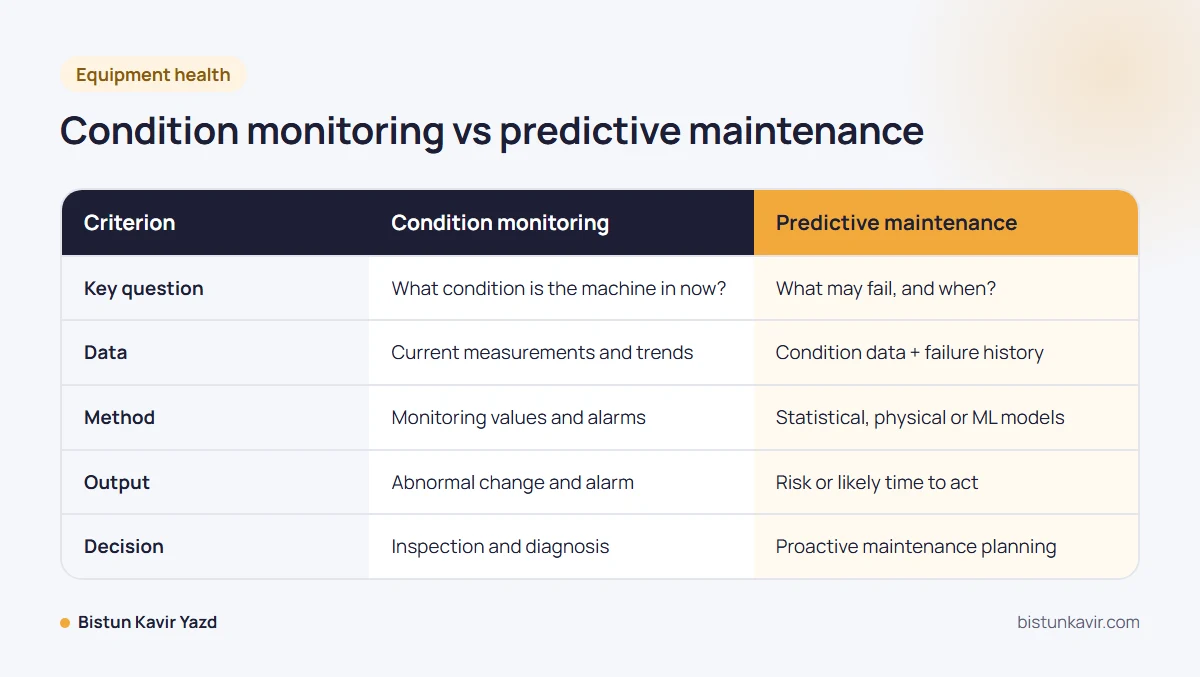
The main difference lies in the question each one answers.
Condition monitoring asks: what condition is the machine in right now, and is there any sign of abnormal behaviour?
Predictive maintenance asks: given the current condition and data trends, what problem might occur in the future, and when should we act?
| Criterion | Condition monitoring | Predictive maintenance |
|---|---|---|
| Main goal | Assess the current condition of equipment | Estimate future changes and likely failures |
| Data required | Current measurements and recorded trends | Condition data, failure history and operating information |
| Analysis method | Monitoring values, trends and alarms | Statistical, physical or machine learning models |
| Output | Health status, abnormal changes and alarms | Estimated failure risk or likely time to act |
| Operational decision | Investigation, inspection and fault diagnosis | Proactive maintenance planning |
| Main limitation | Detecting change does not necessarily reveal when failure will occur | Predictions depend on data quality and model validity |
The two approaches are not opposed. In many applications, condition monitoring provides the data infrastructure that predictive maintenance needs.
Put simply, to predict the future condition of equipment, you usually first need to measure and analyse its current condition and trends correctly.
Preventive, condition-based and predictive maintenance compared
To understand where predictive maintenance fits, it helps to distinguish it from other approaches to maintaining mining equipment.
Corrective maintenance
In this approach, action is taken to fix a problem after a failure or malfunction has been identified.
For example, if a component breaks, the maintenance team works to return the machine to service.
Corrective maintenance does not always mean waiting for a complete failure; a defect may be found during inspection and its repair planned.
Preventive maintenance
Preventive maintenance includes activities planned to reduce the likelihood of failure or performance loss.
Periodic services based on operating hours, calendar time or manufacturer instructions are examples of this approach.
An oil change or specific inspection after a set number of operating hours, for instance, can be part of a preventive maintenance plan.
Condition-based maintenance
In condition-based maintenance (CBM), maintenance decisions are based on information about the equipment's actual condition.
For example, if oil analysis of a drivetrain shows abnormal contamination or wear particles, an inspection or repair may be carried out earlier than the periodic schedule.
Here, the maintenance action depends on the measured condition rather than just the time since the last service.
Predictive maintenance
Predictive maintenance goes one analytical step further, using data trends, models and failure patterns to estimate future condition.
Its aim is to help choose the right time to act before the equipment reaches an undesirable condition.
In some industrial applications, however, the line between CBM and predictive maintenance overlaps, and predictive maintenance is often regarded as an advanced form of condition-based maintenance.
Technologies used for condition monitoring of mining equipment
Because of heavy loads, long operating hours and harsh environments, mining equipment needs monitoring methods suited to the type of work.
Data can be collected through sensors fitted to the machine, onboard controllers, specialist measuring equipment and periodic tests.
Vibration monitoring
Vibration analysis is a well-established method for checking the condition of rotating components such as bearings, electric motors and some drivetrain assemblies.
Changes in vibration amplitude or frequency pattern can reveal certain mechanical problems.
On mobile mining machines, however, vibration caused by road surfaces, impacts and load changes can complicate the analysis, so the measurement method must suit the equipment and its operating conditions.
Oil analysis
Oil analysis can provide information on lubricant condition, contamination and wear particles from components.
For example, an abnormal change in the concentration of certain metals in an oil sample may call for an inspection of the related components.
The data should be interpreted in light of the oil type, operating hours, sampling method and machine history.
Temperature and pressure monitoring
Changes in temperature and pressure in the engine, cooling system and hydraulic circuits can signal a change in operating conditions.
On many machines, onboard controllers can log some of this information and raise alarms.
To diagnose a problem, though, the data must be matched against conditions such as engine load, ambient temperature and machine activity.
Fault codes and controller data
Machines with electronic controllers may record information such as fault codes, operating events and performance parameters.
This data can be used to identify recurring patterns and investigate technical problems.
The information that can be extracted depends on the manufacturer, machine model and level of access to its electronic systems.
Condition monitoring of mining haul trucks
Haul trucks make up a large share of material-moving capacity in open-pit mines, and their sudden breakdown can affect trip counts, tonnage hauled and shovel performance.
On suitably equipped trucks, parameters such as engine temperature, oil pressure, cooling system status, drivetrain data, fault codes and operating hours can be reviewed.
For example, a steady temperature rise in part of the drivetrain may call for a check of lubrication, loading conditions or other technical factors.
A condition monitoring system records the abnormal change and flags it for review. A predictive maintenance system can also analyse the trend and estimate the likelihood of the problem getting worse, provided valid data and models are available.
Operational benefit for the haul fleet
Early warning of possible problems can help maintenance schedule inspections around the shift plan.
Where possible, good maintenance planning can also reduce the time needed to source parts and assign a replacement machine.
The decision to keep operating a truck with an active alarm must, however, follow the manufacturer's instructions and safety requirements.
Condition monitoring of mining shovels and loaders
Heavy shovels and loaders are subject to variable loads and repetitive work.
On these machines, the hydraulic system, oil temperature, engine performance, circuit pressures and the condition of some mechanical components can be included in the monitoring programme.
For example, a rise in hydraulic oil temperature under comparable working conditions may be linked to reduced cooling efficiency, a change in oil flow or increased thermal load.
Monitoring this trend can help detect abnormal conditions, but finding the exact cause requires a technical inspection.
On large shovels, an unplanned stoppage can affect several haul machines. Managing the health of this equipment therefore matters not only to maintenance but also to mine operations planning.
Worked example: from a condition alarm to a maintenance decision
Suppose the hydraulic oil temperature of a shovel is reviewed over several consecutive shifts.
At the start of the period, the temperature is fairly stable under similar loads and ambient temperatures. In later shifts, the average temperature rises, and this happens repeatedly.
Three levels of analysis are possible:
| Level of analysis | Result |
|---|---|
| Condition monitoring | An abnormal temperature rise compared with the machine's history is detected |
| Fault diagnosis | The technical team reviews related parameters to assess the likely cause of the rise |
| Predicting future condition | If a valid model exists, the likelihood of the problem worsening or reaching an undesirable state is estimated |
At the first level, the system simply shows an abnormal change.
At the second level, specialists try to identify its cause.
At the third level, trend analysis may help decide when to inspect or repair.
This example is hypothetical. A temperature rise alone does not mean a definite failure or that the system's breakdown time can be predicted.
Can the failure time of mining equipment be predicted?
For some equipment and some failure modes, it is possible to estimate when an undesirable condition is likely to be reached.
One concept used here is remaining useful life (RUL).
RUL refers to the estimated time remaining until the health of a piece of equipment or component reaches a defined failure threshold.
This estimate can be useful for planning maintenance, but it is not certain.
For example, changes in loading, lubrication quality, ambient temperature or operator behaviour can change how quickly a component wears.
For this reason, predictive models should be evaluated together with their uncertainty, limits of application and new data.
Also, for some sudden failures or events with no measurable warning signs, reliable prediction is not possible.
The role of VHMS in monitoring mining equipment health
A Vehicle Health Monitoring System (VHMS) is one of the technologies used to collect and review information about the technical condition and performance of heavy equipment.
The term is particularly well known in the mining equipment industry. Komatsu, for example, has used VHMS on some of its equipment, which in newer products is associated with Komtrax Plus.
Depending on the machine and installed features, such systems can give users data such as operating hours, fault codes, operating conditions and some component health parameters.
Is VHMS the same as predictive maintenance?
No. A VHMS can provide the infrastructure for collecting and monitoring machine health data, but having one does not by itself mean having accurate failure prediction.
Moving from condition monitoring to predictive maintenance usually requires a set of additional capabilities:
- Reliable historical data on equipment condition
- Records of failures and repairs carried out
- Fault diagnosis and trend analysis methods
- Validated models for estimating risk or future condition
- A clear process for turning alarms into maintenance actions
In smart mining projects, these capabilities can be developed step by step to match the mine's needs.
How do you implement condition monitoring of mining equipment?
Installing sensors and displaying data is only part of a successful condition monitoring programme. The programme should be designed around equipment criticality and the real needs of the operation.
Step 1: Select critical equipment
First, identify the machines whose failure has the greatest impact on safety, production or operating costs.
In an open-pit mine, this group may include the main loading shovel, key haul trucks or some support equipment.
Failure history, downtime cost and criticality analysis can be used to set priorities.
Step 2: Identify failure modes
Once equipment is selected, determine which failures matter most and which warning signs can be measured before they occur.
In a hydraulic system, for example, oil temperature, circuit pressure and oil analysis data may help assess certain failure modes.
At this stage, methods such as failure mode and effects analysis (FMEA) can help set priorities.
Step 3: Choose the data and measurement method
The type of data needed should follow from the monitoring goal.
Some information may come from the machine's onboard controller, while some parameters need a sensor or specialist test.
Sampling rate, measurement quality, site communications and data storage also need to be defined.
Step 4: Define the normal operating range
To detect abnormal changes, you first need to know how the equipment normally behaves under different operating conditions.
For example, a shovel's oil temperature under heavy load may differ from the same machine's temperature at light load.
Comparisons should therefore take working conditions into account, and alarm limits should be set based on manufacturer guidance, engineering analysis and reliable data.
Step 5: Define the alarm review process
Once an alarm is raised, it must be clear which unit is responsible for reviewing it and what actions follow.
An alarm may require a data review, a technical inspection, oil sampling or immediate action under safety procedures.
Without such a process, more alarms do not necessarily lead to better maintenance management.
Step 6: Link condition monitoring to the maintenance plan
To use the information effectively, monitoring results must feed into maintenance planning.
Raising work orders, prioritising inspections, planning shutdowns and recording repair results all make it possible to assess how effective condition monitoring is.
Repair data can also be used to refine alarm thresholds and improve analytical models.
Benefits of condition monitoring and predictive maintenance in mines
The main value of these approaches is better information for decisions about equipment health.
Lower risk of unplanned downtime
Detecting some abnormal changes early may give enough time for a planned inspection or repair.
This benefit depends on the failure mode, how early it can be detected and how quickly the maintenance team responds.
Better maintenance planning
When the technical condition of equipment can be seen and analysed, maintenance can plan part of its work based on the machine's actual condition.
This can help prioritise inspections and coordinate repairs with the production plan.
Better spare parts management
Where changes in component condition are detected earlier, parts procurement can be planned more effectively.
Critical parts may still need a defined stock and emergency supply policy, however.
Higher operational reliability
Combining condition monitoring with a sound maintenance plan can help manage equipment reliability better.
To evaluate the results, performance indicators should be compared before and after the system is introduced, under comparable conditions.
Indicators for evaluating a condition monitoring system
A set of operational and technical indicators can be used to measure the effectiveness of a condition monitoring or predictive maintenance programme.
| Indicator | What it evaluates |
|---|---|
| MTBF | Mean time between failures for repairable equipment |
| MTTR | Mean time to repair and return equipment to service |
| Unplanned downtime | Trend in time lost to breakdowns |
| Equipment availability | Readiness of machines for operations |
| Actionable alarm rate | Quality and usefulness of alarms |
| Planned maintenance share | Proportion of maintenance work that could be planned |
For example, less unplanned downtime may be one sign of an improved maintenance programme, but before attributing the change to the monitoring system, other factors such as activity levels, fleet size and changes to the maintenance plan should also be reviewed.
Challenges of predictive maintenance in Iranian mines
Implementing predictive maintenance in mines, especially those running machines of different ages and technologies, can face limitations.
One important challenge is access to reliable, integrated data. Some equipment provides technical information digitally, while older machines may need add-on equipment or periodic measurement.
Another challenge is the lack of structured records of failures and repairs. Without this information, it is hard to evaluate how well prediction models perform.
Site conditions such as dust, vibration, temperature swings and communication limits can also affect measuring and data transmission equipment.
And collected data only creates operational value when maintenance specialists can interpret it and turn it into concrete actions.
For many mines, starting with monitoring of critical equipment and gradually building analytical capability may be a better approach than rolling out a complex prediction system across the whole fleet.
Condition monitoring in mining equipment digitalisation with Bistun
Bistun Kavir Yazd, a knowledge-based company, develops smart mining systems, fleet management and mining equipment monitoring solutions.
In a smart mine architecture, equipment health data and fleet operating data are two related but distinct areas.
Machine health data, for example, can be used to review technical condition and plan maintenance. Dispatching and fleet performance data, by contrast, help managers review equipment activity, stoppages and haul assignments.
How VHMS relates to mine operations management
VHMS, one of Bistun's product areas, covers monitoring of machine health and technical condition.
The BiSmart system, meanwhile, focuses on operations management, fleet monitoring and dispatching, giving mine managers information on machine activity.
Where the infrastructure for integration exists, these two kinds of data can be used together for maintenance decisions and operations planning.
For example, knowing a machine's technical condition can help plan its removal from the haul cycle and assign a replacement.
In this approach, equipment health monitoring and operations management play separate roles but complement each other.
To review your machine health monitoring needs and choose infrastructure suited to your mine's equipment, you can request a technical review through Bistun Kavir Yazd's contact page.
Frequently asked questions about condition monitoring and predictive maintenance
What is the main difference between condition monitoring and predictive maintenance?
Condition monitoring focuses on measuring and analysing the current condition of machines, while predictive maintenance uses condition data and analytical methods to estimate likely future problems and plan maintenance actions.
Can condition monitoring prevent every equipment failure?
No. Some failures happen without any prior measurable sign. Condition monitoring can help detect some problems early, but it does not replace technical inspections, preventive maintenance or safety requirements.
Is VHMS the same as a predictive maintenance system?
Not necessarily. VHMS usually focuses on collecting and monitoring machine health information. Turning that data into failure prediction requires analytical capability, reliable records and suitable models.
Which machines should be prioritised for condition monitoring?
Machines whose failure has the greatest impact on safety, production or operating costs are usually prioritised. These may include main shovels, critical haul trucks and other key mine equipment.
Can older mining machines be condition-monitored?
In many cases, add-on sensors, measuring equipment and periodic inspections can be used. The level of monitoring that is feasible depends on the machine type, access to measurement points, installation conditions and the project's economic case.
Does predictive maintenance reduce mine maintenance costs?
Under the right conditions, it can help reduce some costs caused by sudden breakdowns and improve maintenance planning. The economic result depends on implementation cost, data quality, analytical accuracy and the effectiveness of maintenance actions.
Conclusion
Condition monitoring and predictive maintenance are complementary approaches to managing the health of mining equipment.
Condition monitoring makes it possible to review the current state of equipment and detect abnormal changes. Predictive maintenance uses condition data, performance history and analytical models to estimate future changes and the likely need for maintenance.
In open-pit mines, using this information well can support better maintenance planning, management of sudden stoppages and higher fleet reliability.
Successful implementation, however, requires reliable data, the right indicators and cooperation between operations, maintenance and IT.
With a focus on equipment monitoring systems and smart mine operations management, Bistun Kavir Yazd can help assess solutions suited to each mine's infrastructure and technical needs.
To learn more and get advice on monitoring mining equipment, visit the Bistun Kavir Yazd website.
Sources
- ISO 17359:2018 — Condition monitoring and diagnostics of machines: General guidelines
- ISO 13381-1:2025 — Prognostics: General guidelines and requirements
- ISO 13374-1:2003 — Condition monitoring data processing and communication
- Komatsu — Komtrax Plus: Remote Monitoring of Mining Equipment
- Komatsu — Prognostics and Health Monitoring